Cloud Server Vulnerability Scanning: Regular Checks Keep Hidden Risks at Bay
Last year, a client told me they did an annual security audit and kept their systems updated, so they felt confident. Then they were compromised. The attack used a known OpenSSL vulnerability — CVE had been public for six months, a patch had been available for ages, and they’d never applied it.
"We updated everything, didn't we?" they asked.
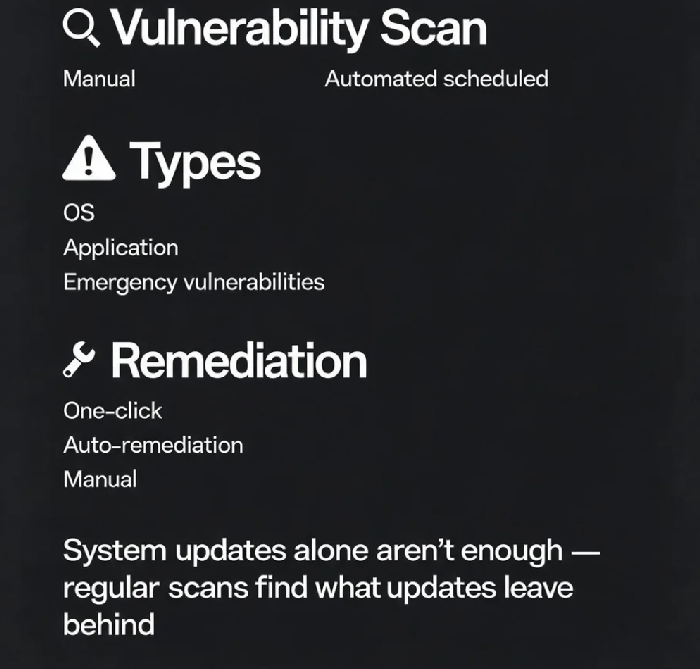
They had run updates, but that doesn't fix everything. Misconfigurations, open ports, and weak passwords don't get patched by apt upgrade. Vulnerability scanning is how you find the gaps that updates leave behind.
01 Where Do Vulnerabilities Come From?
When most people hear "vulnerability," they think "outdated software." But attackers use a lot more than that.
OS vulnerabilities – Flaws in the kernel, system services, or core libraries that can lead to privilege escalation.
Application vulnerabilities – Bugs in web apps or middleware that may allow SQL injection, remote code execution, or other attacks.
Configuration vulnerabilities – Misconfigured systems with unnecessary open ports, disabled security features, or overly permissive access controls.
Weak passwords – Simple or reused credentials that can be guessed or brute‑forced.
Unpatched systems – Software that's out of date but still exposed, often the easiest route for attackers to take.
Attackers often combine known CVEs with misconfigurations — it's not sophisticated, but it works. Regular updates are only the first step; proper vulnerability management needs broader coverage.
02 Vulnerability Scanning Tools
Cloud‑native solutions – If you're on Alibaba Cloud, Tencent Cloud, or Huawei Cloud, their security centers usually have built‑in vulnerability scanning. Alibaba Cloud Security Center supports scanning for five types of vulnerabilities: Linux/Windows system vulnerabilities, Web‑CMS, application, and emergency vulnerabilities, and it provides one‑click fixes for some CVE system vulnerabilities.
Tencent Cloud Host Security also supports periodic and on‑demand vulnerability scanning for Linux and Windows hosts.
Open‑source tools – OpenVAS is a full‑featured vulnerability scanner that can be installed on Kali Linux and used to scan networked devices. Nessus Essentials provides a free version that can scan up to 16 IP addresses, which is often enough for smaller environments.
03 Scanning Frequency and Strategy
Automatic scanning is the baseline. Alibaba Cloud Security Center's Enterprise and Flagship editions scan Linux and Windows system vulnerabilities daily. Tencent Cloud Host Security also supports automatic scheduled scans on a daily, three‑day, weekly, or bi‑weekly cycle.
Manual scanning is useful for emergency response after a new CVE is disclosed or during incident response. Security centers typically support one‑click manual scanning across all servers.
Scheduling considerations – Run scans during off‑peak hours. Most cloud providers default to the 00:00‑07:00 window for Chinese regions to minimise business impact. Full‑port or high‑concurrency scans can briefly consume bandwidth and CPU, so they should be scheduled during low‑traffic periods with appropriate concurrency limits.
04 Vulnerability Remediation Priority
Not all vulnerabilities are equally urgent. Use CVSS scores to set priority. Patches that can be exploited remotely should be fixed first, because they don't require local access. Vulnerabilities with public exploit code should also be prioritised — the attack barrier is effectively zero.
Cloud security centres also apply contextual scoring by factoring in time‑since‑release, the actual environment, and asset criticality to help filter out the real risks.
The Bottom Line
That client eventually set up a vulnerability scanning process: monthly automated scans, high‑severity issues patched within three days. "I didn't know that scanning and system updates were two different things," they admitted.
Vulnerability scanning is a compliance requirement for MLPS 2.0, and it's a routine part of security operations. Most cloud security centres have the capability built in — just turn it on. Is your server vulnerability scanning enabled yet?