Connecting a Global Player Base: The Architecture of Game Acceleration Networks for the Chinese Market
Let's talk about something that kills great games: the silence. It's not the silence of an empty server, but the quiet, collective sigh of players giving up—when a perfectly timed skill shot disappears into the digital void, or a character stutters across the screen just as victory was in hand. The culprit is almost never the game design or the art. It's the treacherous, unpredictable journey a data packet must make between a player in, say, Shanghai, and a game server in Frankfurt. That journey, often exceeding 200 milliseconds (ms) on the public internet, can erase months of development effort in an instant.
If you're aiming to connect with the massive and discerning Chinese player base from overseas, you're not just facing the Pacific Ocean; you're navigating a unique digital topography. A staggering 68% of Chinese players have stated they will abandon an international server game due to persistent high latency. The business impact is stark: data shows that network latency can directly influence player retention and spending. Reducing latency for players in a region like Southeast Asia from 200ms to 50ms has been linked to a 19% increase in paid user conversion rates. This isn't just a technical hurdle; it's the fundamental architecture of your game's global relationship with its players.
The common misconception is that placing a server in Hong Kong or Tokyo solves everything. The reality is more complex. China's network environment is defined by three critical layers: international gateway bottlenecks, inter-carrier barriers between giants like China Telecom, China Mobile, and China Unicom, and the unpredictable "last mile" to individual users. This means low latency isn't just about geographical proximity; it's about intelligent network integration.
So, how do you build a bridge that doesn't just exist, but performs? The answer lies in a purpose-built, multi-layered acceleration architecture.
The Three-Layer Blueprint for Seamless Play
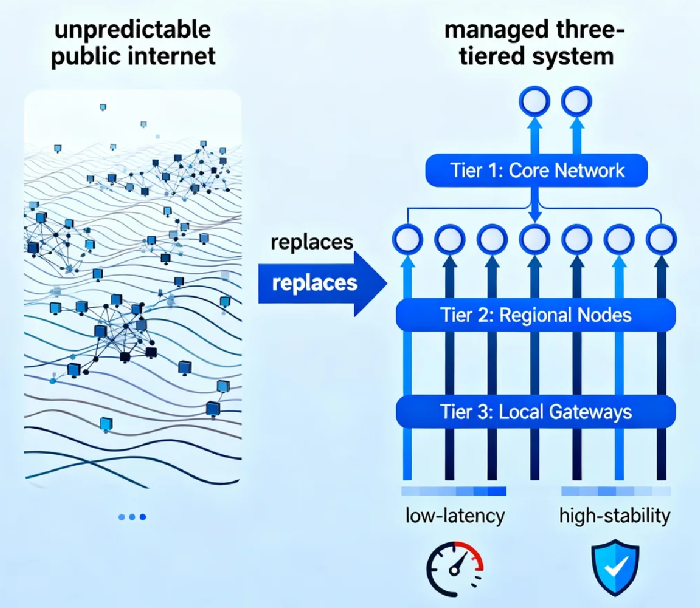
A professional game acceleration network is far more than a simple proxy or VPN. It is a sophisticated, three-tiered system designed to own and optimize every segment of the data's journey.
Layer 1: The Intelligent Edge (The Local Greeting)
This is where the player first touches your network. The goal here is to intercept their traffic as close as possible, within mainland China or at highly optimized adjacent hubs. Leading cloud providers like Tencent Cloud and Alibaba Cloud operate massive networks of edge nodes within the region for this purpose.
Function: This layer performs initial connection stabilization, protocol optimization for real-time game traffic (like UDP or WebSocket), and basic security filtering to mitigate DDoS attacks at the doorstep.
Key Insight: It's not about having the most nodes, but about having strategically placed, high-quality nodes with excellent interconnection. A mesh of 20-30 key locations is often more effective than a scattered hundred, preventing disruptive "node-hopping" for players.
Layer 2: The Sovereign Highway (The Optimized Transit)
This is the core of the acceleration magic. Once traffic is gathered at the edge, it must cross international borders not via the congested public internet, but through a private, high-performance backbone.
Function: This layer employs intelligent routing systems that continuously monitor global network conditions—latency, jitter, packet loss on dozens of possible paths. It dynamically chooses the optimal route, which could be a premium dedicated line (like CN2 GIA), a multi-carrier BGP blend, or another high-grade通道.
Key Insight & Data: The public internet is plagued by "route wandering." Smart routing can reduce cross-border packet loss from a typical 3-5% to under 0.5%, a transformative improvement for real-time sync. Solutions like Alibaba Cloud's Global Accelerator (GA) are built precisely for this, creating a stable "data superhighway" from the edge directly to your server hub.
Layer 3: The Global Brain (The Final Dispatch)
After its high-speed transit, traffic arrives at your server region. This layer ensures it is flawlessly delivered to the correct game server instance.
Function: It handles global server load balancing, session persistence (so a player isn't bounced between paths mid-match), and integrates with your game's matchmaking to place players in server instances that offer the best collective latency.
Key Insight: This layer provides the observability you need—global latency heatmaps, player distribution analytics, and per-connection diagnostics—to continually tune the entire system.
Beyond Acceleration: The Integrated Toolset for Modern Games
A cutting-edge network does more than move bits quickly. For the Chinese market, it must be part of a holistic technical solution.
Security as Standard: The network itself should be your first line of defense, absorbing and scrubbing DDoS attacks before they ever reach your game servers, a critical capability in a competitive landscape.
Compliance & Ecosystem: Navigating local regulations is non-negotiable. Partnering with providers who have deep regional expertise and compliance certifications (whether for data or content) is as crucial as low latency itself.
The Protocol Imperative: Modern games use a mix of TCP for reliability and UDP for speed. Your acceleration architecture must be protocol-agnostic, optimizing both simultaneously. Advanced solutions offer this at the transport layer (Layer 4), ensuring no part of your game's conversation is left behind.
The Horizon: Where Network Meets Game Design
The future of this architecture is its fusion with game logic. We're moving from accelerating data to relocating computation.
Edge Computing Meets Gameplay: Research institutions like IMDEA Networks are demonstrating how processing data on servers inside mobile networks (like 5G towers) can dramatically cut latency. Imagine offloading non-core deterministic calculations—proximity checks, certain NPC behaviors, or physics for non-critical objects—to these edge locations. This reduces round-trips to zero for those actions, opening new design possibilities for real-time genres.
AI-Driven Optimization: The next frontier is predictive networks. Using machine learning to analyze player movement and game state, the system could pre-fetch assets or pre-establish optimal routes for predicted actions, creating the illusion of zero-latency play.
Building Your Bridge
Architecting for the Chinese player is an exercise in respect—for their expectations, their competitive spirit, and their experience. It requires shifting your mindset: the network is not a utility, but a core, active component of your gameplay, as essential as a responsive control scheme or a balanced map.
The data is unequivocal. Investing in a professional, layered acceleration architecture directly protects and enhances your commercial metrics: player retention, session length, and revenue. It transforms the network from a source of silent frustration into an invisible pillar of trust and quality. When your players in Shanghai can duel, cooperate, and share moments with your community in Seattle or Stockholm without a second thought to the distance, you have done more than solved a technical problem. You have built a true world, seamlessly connected, where the only thing that travels faster than light is the joy of play.