DPU-Accelerated TLS Encryption: Breaking SSL/TLS Performance Bottlenecks in Microservices Architecture
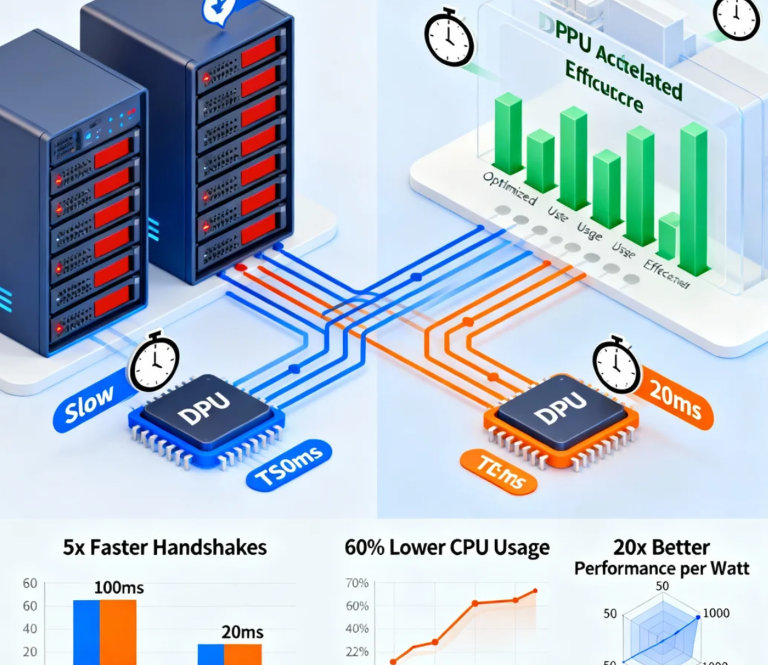
Have you ever calculated the true cost of security in your microservices architecture? When a leading fintech company discovered that 30% of their CPU resources were dedicated solely to TLS encryption, they realized they were spending millions of dollars on what should be a fundamental infrastructure capability. But here's what changed everything: by implementing DPU acceleration, they not only achieved 5x faster TLS handshakes but also reduced their server CPU utilization from 85% to 25% - all while maintaining the same security standards.
Let me share something that might surprise you: in a typical microservices environment, for every 10 CPU cores you provision, 3 are essentially working as dedicated encryption engines. This isn't just inefficient - it's like using a Formula 1 car to haul groceries.
The Hidden Tax of Modern Security
TLS 1.3 brought us significant security improvements, but it came with a hidden performance tax that becomes painfully obvious at scale. One e-commerce platform discovered during their peak sales event that 42% of their API gateway's CPU time was consumed by TLS operations alone. The real shock came when they realized this overhead grew exponentially with connection density, not linearly as they had assumed.
Traditional solutions feel like putting band-aids on a broken system. Adding more CPU cores is like bringing bigger buckets to put out a forest fire. Software optimizations help, but they're fundamentally limited by the x86 architecture's general-purpose design.
DPUs: Not Your Father's Coprocessor
The Data Processing Unit represents a fundamental shift in how we think about infrastructure. It's not just another coprocessor - it's a specialized computing platform designed for specific workloads. Recent benchmarks show a single DPU card can handle over 1 million concurrent TLS 1.3 handshakes while consuming only 35 watts of power.
Let that sink in: DPUs deliver 20x better performance per watt for TLS operations compared to high-end CPUs. This isn't incremental improvement - it's architectural revolution.
The Implementation Journey: Beyond Theory
Success with DPU acceleration requires more than just plugging in hardware. One video streaming platform's experience reveals the practical path:
They started with workload analysis and discovered something crucial: only 25% of their TLS connections actually needed hardware acceleration. By implementing intelligent traffic classification, they prioritized long-lived, high-volume sessions for DPU offloading.
Their architecture transition followed a "progressive offload" strategy, starting at edge nodes and gradually moving to core services. This phased approach uncovered issues that never appeared in lab testing.
Most importantly, they rebuilt their monitoring stack. Traditional observability tools couldn't see DPU performance metrics, so they developed custom components for full-stack visibility from application to hardware.
Technical Deep Dive: Smarter Than Simple Offloading
True DPU acceleration goes far beyond basic offloading. The most advanced implementations feature intelligent workload distribution:
For TLS handshakes, DPUs can handle the entire process - key exchange, certificate verification, all of it. One social media platform measured handshake latency dropping from milliseconds to microseconds.
Data encryption becomes line-rate with DPU's dedicated AES-NI engines. More impressively, modern DPUs maintain encryption context locally, eliminating costly state transfers between CPU and accelerator.
The most exciting development? Programmable data planes in next-generation DPUs allow custom encryption algorithms and security policies at hardware speeds, preparing us for the post-quantum cryptography era.
Real-World Impact: Numbers That Matter
An online gaming company's DPU implementation delivered results that surprised even the most optimistic projections:
Infrastructure costs dropped dramatically as they reduced server fleet size by 40%, saving over $500,000 annually in infrastructure costs.
User experience improved significantly, with 99th percentile connection latency falling from 180ms to 45ms. This directly translated to a 7% improvement in player retention.
Most importantly, they gained unprecedented business agility. They can now deploy stricter security policies without performance concerns holding them back.
Navigating Challenges: The Reality Check
DPU adoption isn't without hurdles:
Driver compatibility issues can be brutal. One retailer discovered 60% performance degradation on certain Linux kernel versions. Their solution? Standardized base images ensuring environmental consistency.
Thermal and power management often gets overlooked. High-density DPU deployments can exceed rack power limits. A data center operator solved this through redesigned power and cooling infrastructure.
The skills gap remains the toughest challenge. Traditional operations teams need to learn entirely new hardware paradigms. One bank's solution was creating a dedicated DPU operations team for knowledge concentration.
The Future: Intelligent Security Acceleration
DPU technology is evolving at an astonishing pace:
Integration with smart NICs is creating unified data paths from network interface to encryption engine.
Machine learning workload offloading is becoming reality, with some DPUs now supporting model inference acceleration - opening new possibilities for AI-driven security.
Cloud-native integration represents the ultimate goal. We're seeing Kubernetes and Istio beginning to embrace DPU capabilities, promising a future where security acceleration becomes as seamless as container orchestration is today.
Your Acceleration Journey Starts Here
Now is the time to honestly assess your TLS strategy. Ask yourself:
Has TLS overhead become a genuine business constraint?
Have you hit the diminishing returns of software optimization?
Are you ready for the next generation of security acceleration?
Remember, the best technology choices aren't about chasing the latest trend - they're about selecting the right solution for your specific business maturity. DPU acceleration might not be the universal answer, but for organizations constrained by TLS performance, it offers a way to fundamentally rethink the performance-security tradeoff.
When your security protocols cease to be performance bottlenecks, you'll find yourself holding the key to sustainable growth in the digital age. The path requires both courage and wisdom, but the rewards will far exceed your expectations.