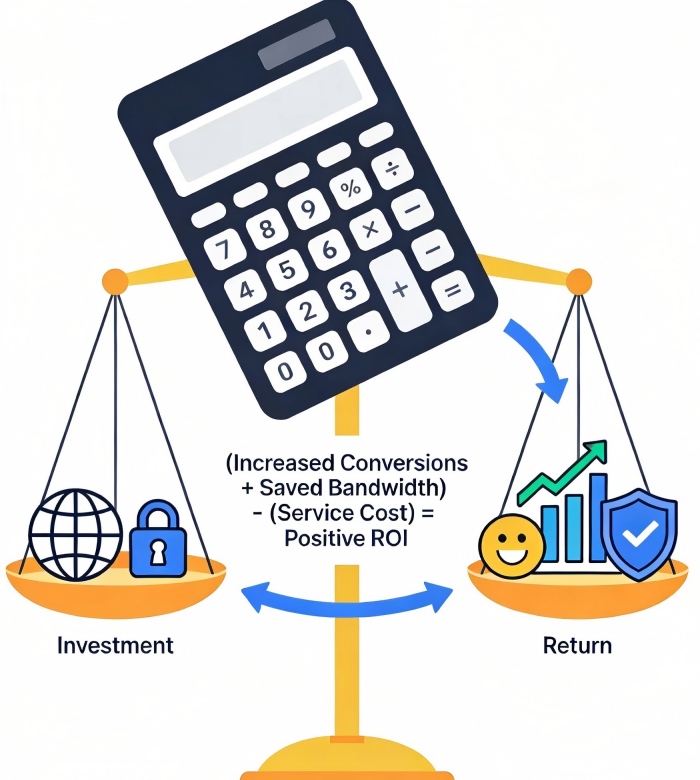
Let’s talk about a common, costly misconception. When the finance team looks at the invoices for your Global CDN and SSL certificates, they likely see two things: a variable cost for bandwidth and a fixed, recurring security tax. The immediate instinct is to negotiate the per-gigabyte rate down and opt for the cheapest SSL certificate that gets the job done. This is a classic case of winning the battle but losing the war.
The truth is, when evaluated in isolation as mere line items, you completely miss their transformative value. A modern CDN paired with robust SSL isn't an IT expense; it's the foundational infrastructure for your digital revenue engine and trust capital. The real return on investment (ROI) isn't found by comparing vendor quotes, but by calculating the revenue they protect, enable, and accelerate.
Today, we're moving beyond the price tag to architect a framework for calculating strategic ROI. We'll examine how this combination acts as a force multiplier for your business, where 1+1 doesn't equal 2, but 5 or more.
Part 1: The Costly Illusion — Why Treating Them as Commodities Fails
The first step is to dismantle the flawed accounting. Viewing CDN as just "bandwidth" and SSL as just "the padlock" leads to two critical errors:
You Optimize for the Wrong Metric. Chasing the lowest CDN cost per GB can lead you to providers with limited node coverage or poor cache optimization. The result? Higher latency for your users in key markets. Industry data shows that page load time delays of just one second can reduce conversion rates by 4-7%. You might save 20% on your CDN bill, but if it makes your site 500ms slower, you could be forfeiting a significant percentage of your monthly revenue without even realizing it.
You Incur Massive "Shadow Costs." The absence of integrated, high-grade security features (like a robust Web Application Firewall or DDoS mitigation) isn't a savings—it's a deferred, high-risk liability. A single successful DDoS attack or data breach can lead to immediate revenue loss, long-term brand damage, and compliance fines that dwarf years of "savings" from a basic plan. Modern CDNs absorb and disperse this attack traffic at the edge, protecting your origin infrastructure from being overwhelmed—a value impossible to quantify until you need it.
The Core Insight: The baseline cost of these services is not their price, but the opportunity cost and operational risk of not having them optimally configured. A poorly implemented CDN can even become a cost center, with low cache hit rates leading to excessive "origin pull" fees and unnecessary load on your servers.
Part 2: The Strategic ROI Framework — Measuring What Actually Matters
To calculate true ROI, we must shift from a cost-centric to an impact-centric model. Here’s a framework to quantify the strategic value across four pillars:
Let’s Put This in Concrete Terms:
Imagine an e-commerce site with $1M monthly revenue. A strategic CDN/SSL deployment:
Increases conversion rate by 1.5% due to speed/trust → +$15,000 monthly revenue.
Reduces origin hosting costs by 40% via caching → -$4,000 monthly cost.
Prevents one major outage per year (e.g., a DDoS attack that would cause 4 hours of downtime) → Avoids ~$5,500 in lost revenue.
The annual net positive impact in this simplified model is over $230,000. Even against a premium service cost of $50,000/year, the ROI is profoundly positive—and this doesn't even price in brand equity or risk reduction.
Part 3: The Future-Proofing Dividend — SSL as a Strategic Asset
This is where we go beyond conventional wisdom. An SSL certificate is often seen as a static commodity. However, in the hands of a forward-thinking provider integrated with your CDN, it becomes a dynamic security and compliance automation engine.
The cutting-edge discussion is no longer about 2048-bit RSA. It's about:
Automated Certificate Management: With certificates validities shrinking, manual management is a operational nightmare and outage risk. Integration that allows for automated issuance, deployment, and renewal is no longer a luxury—it's a core component of reliability.
Post-Quantum Cryptography (PQC) Readiness: The transition to quantum-resistant algorithms has begun. Leading CDN providers are already deploying hybrid PQC certificates. Proactively choosing a partner on this path isn't just about security; it's about avoiding a costly, rushed architectural migration later. This is a strategic, future-looking investment that protects the long-term confidentiality of your data.
Protocol Enablement: Modern SSL/TLS practices enable HTTP/2 and HTTP/3 (QUIC), which are not just about encryption but significant performance boosts themselves. A CDN optimizes this handshake, turning the "security overhead" myth into a performance gain.
Investing in this advanced, integrated SSL capability is a bet on operational simplicity and long-term cryptographic resilience. The ROI is measured in avoided technical debt, maintained compliance in a shifting landscape, and leadership in user trust.
The Final Calculation: From Cost Center to Growth Platform
So, the next time you review that invoice, don't just see a bill. See a report card for your digital experience and a premium on your business continuity insurance.
The question shifts from "How much does it cost?" to "What is the cost of not doing it right?" The strategic ROI of a global CDN and modern SSL is the sum of the revenue they unlock, the costs they erase, the crises they avert, and the future they make possible.
In a world where user patience is measured in milliseconds and trust is displayed in browser address bars, this isn't an IT purchase. It's a capital allocation to your most critical digital assets. The most successful businesses understand that their digital infrastructure isn't a utility to be minimized, but a platform to be optimized—a direct channel to growth, security, and customer confidence. The math, when you look beyond the price tag, is unequivocal.