Cloud Server vs. Physical Server vs. Bare Metal vs. Serverless: A Visual Guide to Your 2026 Infrastructure Decision Logic
It’s 2:00 AM. Another automated billing alert flashes onto your screen, signaling that your cloud spend has, once again, quietly drifted over budget. Meanwhile, in a separate monitoring window, a graph spikes, indicating that your application’s latency is edging toward the danger zone during a routine traffic bump. This isn't an anomaly; it's the daily contradiction of modern infrastructure—paying for elastic capacity you don't use while simultaneously hitting performance limits you didn't anticipate.
This tension is the core symptom of a foundational choice we often get wrong: selecting the wrong computational bedrock for our workloads. The landscape has fractured into four distinct paradigms—Cloud Servers, Physical Servers, Bare Metal, and Serverless—each promising to be the solution. The $32 billion wasted annually on inefficient cloud resources, as reported by Flexera, isn't just a cost issue; it's a massive, collective decision-making failure.
Let’s cut through the marketing gloss. Choosing infrastructure isn't about finding the "best" technology. It's about aligning the inherent personality of your workload with the fundamental economics and constraints of a compute model. This guide will provide you with the logic—culminating in a clear visual framework—to make that alignment intentional, not accidental.
The Four Personalities of Modern Compute
Think of these four options not as sequential upgrades, but as different tools for fundamentally different jobs.
1. The Cloud Server (The Elastic Workhorse)
The cloud virtual machine is the default choice for a generation of developers. Its promise is profound: infinite elasticity, operational simplicity, and a shift from capital expenditure (CapEx) to operational expenditure (OpEx). You trade physical control for unparalleled agility.
The Unspoken Truth: The "elastic" model has a hidden psychological tax: resource lethargy. Instances are provisioned, often over-provisioned "just to be safe," and then forgotten. They become permanent fixtures on your bill, with the average cloud utilization rate languishing between 25-35%. You're not paying for agility; you're often paying for waste dressed as convenience. Furthermore, the shared tenancy of the cloud, while massively improved, can still introduce the "noisy neighbor" effect—unpredictable performance dips caused by other workloads on the same physical host.
Ideal Genetic Match: Modern web applications, microservices architectures, development and testing environments, and workloads with unpredictable, spiky traffic patterns. It's for when speed of iteration and horizontal scaling are more critical than absolute, predictable performance.
2. The Physical Server (The Sovereign Territory)
The traditional dedicated server is the sovereign nation-state of compute. You own or lease the entire physical machine. This means total control, total responsibility, and total isolation.
The Unspoken Truth: Sovereignty comes with the burden of manual diplomacy. Scaling is a physical, slow, and expensive process involving procurement, shipping, and racking. Your team is responsible for everything, from replacing failed hard drives to updating BIOS firmware. The lead time is measured in days or weeks, not seconds. The capital commitment is significant, and you pay for the hardware whether it's at 1% or 100% load. However, this isolation provides something the cloud often can't: guaranteed, unfluctuating performance and the ability to meet stringent data sovereignty or regulatory requirements that mandate physical hardware separation.
Ideal Genetic Match: Legacy monolithic applications that are difficult to containerize, workloads requiring specialized hardware (like particular GPU models), and environments where data must reside on physically isolated, non-multitenant hardware for compliance (financial services, certain government workloads).
3. The Bare Metal Server (The Performance Purebred)
Bare metal is the most misunderstood contender. It is not merely "a physical server by another name." It is a synthesis: the raw, unmediated power of dedicated hardware delivered with the API-driven agility of the cloud. You get a full physical server, but you can provision it in minutes, not weeks, and manage it programmatically.
The Unspoken Truth: The primary value isn't just performance—it's performance predictability. By eliminating the hypervisor layer, you remove a source of latency and performance jitter. This is critical for latency-sensitive financial trading algorithms, real-time rendering, and high-performance computing (HPC) clusters. However, this purity has a cost premium over equivalent virtualized instances, and you still bear the responsibility for the OS and software stack. It's for organizations that have outgrown the "noisy neighbor" problem and are willing to pay a premium for consistency.
Ideal Genetic Match: High-performance databases (Oracle, SAP HANA), real-time analytics platforms, containerized applications at scale (Kubernetes clusters seeking maximum pod density and network performance), and any workload where microsecond-level latency consistency is a business requirement.
4. The Serverless Function (The Ephemeral Specialist)
Serverless represents the ultimate abstraction: you provide the code, the cloud provides everything else. You pay not for reserved capacity, but for precise execution time measured in milliseconds. It promises infinite scale and zero operational overhead.
The Unspoken Truth: The "serverless" name is a brilliant, confusing misdirection. The servers are very much there; you just don't see or manage them. The real revolution is the granular, event-driven economic model. The Achilles' heel is the "cold start"—the latency incurred when a function is invoked after being idle. This makes it unsuitable for user-facing, latency-critical operations unless kept perpetually warm (which defeats its economic purpose). It also introduces significant complexity in debugging and monitoring distributed, event-driven systems.
Ideal Genetic Match: Asynchronous, event-driven tasks (processing file uploads, sending notifications, streaming data transformation), API endpoints with highly variable traffic, and scheduled cron jobs. It’s ideal for gluing together cloud services or building massively parallel data processing pipelines.
The Hidden Decision Axes: What You're Really Choosing
Beneath the feature lists, your choice revolves around three core trade-offs:
Control vs. Agility: This is the fundamental spectrum. Physical servers offer maximum control. Serverless offers maximum agility. Cloud servers and bare metal occupy the middle ground, with cloud leaning toward agility and bare metal leaning toward control with better agility than physical hardware.
Cost Model: Capex vs. Granular Opex: Are you prepared for large upfront investments (Capex) for long-term stability, or do you need the pay-per-use model (Opex)? Serverless takes Opex to its extreme—paying per function execution.
Performance: Predictable vs. Elastic: Do you need guaranteed, consistent performance (predictable), or is "good enough on average" with burstability more important (elastic)? Bare metal and physical servers offer predictability. Cloud servers and serverless offer elasticity, sometimes at the cost of predictability.
The 2026 Infrastructure Decision Logic
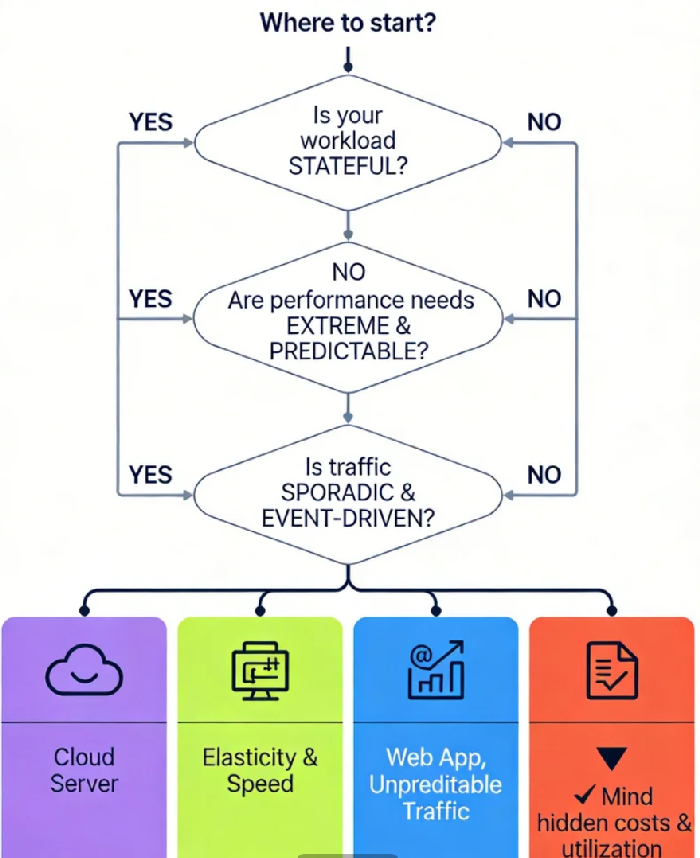
Forget complex feature matrices. Use this logical flow to guide your foundational choice. The following framework is designed to be your primary decision-making tool:
[A visual decision tree would be inserted here]
Textual Logic of the Visual Guide:
Start with the First Principle: Is your workload stateful or stateless?
Stateful (Requires persistent, low-latency access to data): This immediately steers you away from pure Serverless for the core data layer. Proceed to the next question.
Stateless (Requests are independent): All four options are technically on the table. Proceed to the next question.
Ask the Performance Question: Are your performance requirements extreme, consistent, and predictable?
Yes (e.g., HPC, real-time trading, massive relational databases): Move towards the Bare Metal realm. If you have deep hardware expertise and need absolute control, Physical Server remains an option.
No (e.g., web apps, APIs, most business logic): Move towards the Cloud Server realm. Proceed to the final question.
Ask the Scalability & Granularity Question: Is your traffic pattern extremely sporadic, event-driven, or composed of micro-tasks?
Yes (e.g., image thumbnailing, notification triggers, data enrichment streams): Strongly consider Serverless for those specific tasks.
No (e.g., sustained user traffic, background services): Cloud Server is your likely default home.
The Hybrid Truth: The most sophisticated architectures in 2026 won't choose one. They will strategically combine them. A hybrid approach might look like this:
Bare Metal for the core transactional database.
Cloud Servers for the application and web tiers.
Serverless Functions for edge logic, real-time file processing, and email queues.
This "best-of-breed" approach is not a transitional state; it is the end state for complex enterprises.
Beyond the Hype: The Human Element
Technology choices are ultimately about the people who build and maintain them. A Serverless architecture demands a team skilled in distributed systems observability and event-driven design. A rack of physical servers demands old-school hardware and network ninjas.
The worst decision you can make is to choose an infrastructure that misaligns with your team's DNA. Sometimes, the "technically inferior" choice that your team can fully master and operate confidently is superior to the "cutting-edge" solution that becomes a source of constant outages and anxiety.
That 2:00 AM alert isn't just about code or configuration. It's the echo of a strategic decision made months ago. The goal isn't to avoid alerts entirely, but to ensure that when they come, they're for problems worth solving—not for bills inflated by idle resources or performance crippled by an architectural mismatch. Choose based on the genetic makeup of your workload and your team, and you'll build a foundation that scales not just in capacity, but in clarity and confidence.