The 95% vs. 65% Divide: Is Your Cache Hit Ratio Secretly Sinking Your CDN Budget?
Let's cut straight to the chase. You review your monthly cloud bills, and the CDN line item is a constant source of friction. It feels volatile, unpredictable, and despite your best efforts at negotiation, it never seems to shrink meaningfully. The instinct is to blame rising traffic or scrutinize the per-gigabyte rate from your provider. But what if I told you the most powerful lever for cost control isn't on your vendor's price sheet? It's a single, often-overlooked metric quietly operating within your own configuration: your Cache Hit Ratio.
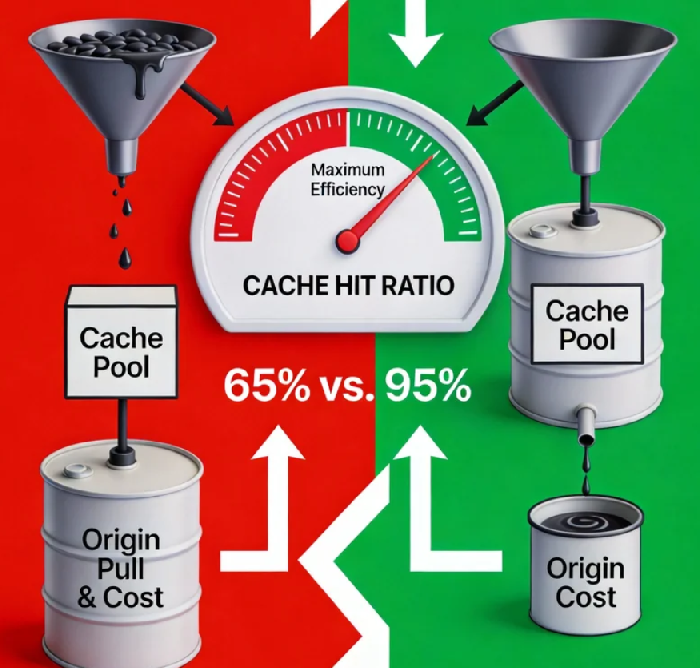
Picture two companies with identical traffic. Company A enjoys a 95% cache hit rate. Company B struggles along at 65%. The financial chasm between them isn't marginal; it's catastrophic. Data indicates that moving from a suboptimal hit rate to above 95% can slash CDN costs by a staggering 30% to 70%. This isn't just about efficiency; it's about fundamental fiscal responsibility for your digital presence. That 30-percentage-point gap isn't merely a technical statistic—it's the invisible hand steering your budget toward a cliff or calm waters.
The Silent Budget Killer: Understanding the "Cache Miss Tax"
To grasp why this number holds such power, you need to understand the mechanics of a cache miss. When a user requests a file—say, a product image—your CDN network checks its vast fleet of edge servers worldwide. If the file is cached there (a hit), it's delivered in milliseconds. If not (a miss), the request must travel all the way back to your origin server.
This "origin pull" triggers a cascade of expenses:
Higher Bandwidth Costs: Traffic from the edge to your origin is often more expensive than edge-delivered traffic.
Origin Load & Scaling Costs: Every miss consumes CPU, memory, and I/O on your origin, potentially forcing you to over-provision expensive infrastructure.
Performance Debt: The added latency of a round-trip to the origin degrades user experience, which studies have linked directly to lost revenue.
At a 65% hit rate, over one-third of your user requests are incurring this "miss tax." This is the primary reason CDN expenses can spiral 30-70% above expectations. The cache hit ratio, therefore, isn't just a performance metric; it's the single most influential indicator for CDN cost control.
Beyond Simple Caching: The Architecture of a High-Hit-Rate System
Achieving a elite hit rate like 95%+ requires moving beyond default settings. It demands a strategic architecture for your content.
1. Intelligent, Multi-Layer Caching Policies
The core principle is to cache more, and cache smarter. This starts with aggressive, rules-based caching for static assets. Set Cache-Control: max-age=31536000 (one year) for immutable resources like versioned JavaScript, CSS, and images. However, sophistication lies in differentiation. Use URL path patterns to apply different policies; cache /static/ assets for weeks, while caching user-specific paths for mere minutes or not at all.
A critical lever is cache key optimization. By default, a URL like style.css?v=1.2 and style.css?v=1.3 may be cached as two different objects. Configure your CDN to ignore irrelevant query parameters (like tracking variables) to prevent cache fragmentation. Conversely, if key parameters change the content (like ?width=300), ensure they are included in the key. This fine-tuning can dramatically increase cache reuse.
2. Mastering the Content Lifecycle: Pre-warming and Purging
A high hit rate requires proactive management. Before a major product launch or marketing campaign, use cache预热 APIs to actively push critical assets to the global edge. This ensures the first wave of users gets a fast experience and avoids a storm of origin misses.
When you update a file, you must purge the old version from the CDN's cache. Be surgical: purge specific URLs or directories instead of full domains to preserve other cached items. For frequent updates, consider a versioned file naming strategy (e.g., app-v2.3.1.js), which makes caching permanent and eliminates purge costs altogether.
3. The Dynamic Content Frontier
The traditional view is that dynamic content (APIs, personalized pages) can't be cached. This is now obsolete. Techniques like Edge Side Includes (ESI) allow you to break a page into static fragments (cached at the edge) and dynamic fragments (fetched per request), significantly reducing origin load. Furthermore, some CDNs offer edge computing that lets you run logic to personalize or modify responses at the edge, turning previously uncacheable requests into cacheable ones.
The Future of Caching: Learning Algorithms and Beyond
The next frontier is moving from static rules to adaptive intelligence. Research into machine learning for caching, like the HR-Cache framework, shows promise. These systems analyze request patterns to predict which objects are most valuable to cache, potentially outperforming traditional algorithms like LRU by significant margins. They can adapt to changing user behavior, optimizing not just for hit rate, but for overall cost and performance savings. While not yet ubiquitous, they point to a future where cache management is a self-optimizing system.
Turning Insight into Action: Your Audit Checklist
Stop thinking of your CDN as a black-box utility. Start treating its cache as a critical, manageable asset. Begin with a simple audit:
Measure: What is your current global and regional cache hit ratio? Monitor it as a core business metric.
Analyze: Use CDN logs to identify your top 10 uncached resources. Are they static? Why aren't they cached?
Configure: Implement a layered caching policy. Aggressively cache static assets, use smart cache keys, and explore techniques for dynamic content.
Iterate: Cache optimization is continuous. Set a goal to improve your hit rate by 5% each quarter and measure the impact on your bill.
The divide between 95% and 65% is more than a number—it's a reflection of operational maturity. In an era where every millisecond of latency and every dollar of infrastructure cost counts, mastering your cache hit ratio is no longer a niche technical task. It's a direct, powerful form of financial and experiential governance for your digital footprint. The question isn't whether you can afford to optimize it; it's whether you can afford not to.