The Hidden Game of Tech Procurement: Avoiding Cognitive Biases & Organizational Pitfalls in Server, SSL & CDN Selection
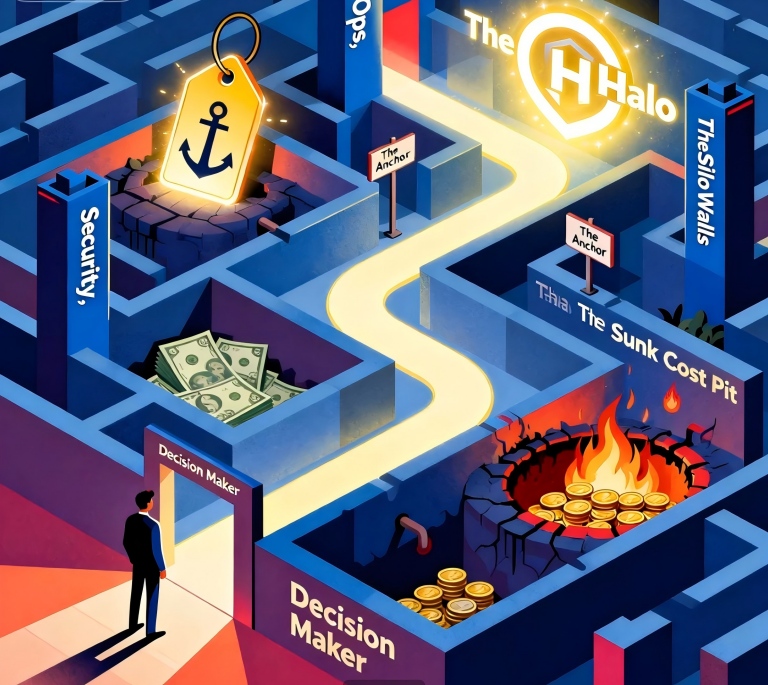
Let’s be honest about what happens behind closed doors. When your infrastructure lead champions a premium dedicated server cluster, they might be unconsciously governed by the ghost of a catastrophic outage from three years ago. When the CISO insists on a specific brand of EV SSL certificate, they are often defending more than a security standard—they are defending their department’s organizational authority and perceived value. The meeting might be about technical specifications, but the real negotiation is happening in a shadowy arena of memory, bias, and territorial instinct.
I’ve sat through those three-hour procurement marathons. The operations team presents Plan A: a high-spec elastic compute package from a hyperscaler, citing scalability and mature ecosystems. The architecture team counters with Plan B: a self-managed bare-metal cluster, arguing for lower long-term cost and performance control. Both spreadsheets are flawless, both logics airtight. Yet, a decision remains elusive.
Here’s the uncomfortable truth we must confront: technology selection is never a purely rational calculation. It is a complex, hidden game riddled with cognitive biases, organizational politics, and emotional memory. The gravest risk isn’t choosing the wrong technology, but having the entire decision-making process hijacked by invisible psychological traps, resulting in a “strategic technical debt” that silently mortgages your company’s future.
Anchoring Bias: How the First Number You See Becomes Your Budget
In behavioral economics, the anchoring effect describes our tendency to rely too heavily on the first piece of information offered. In tech procurement, this “anchor” is often the first vendor quote you receive, the configuration your predecessor built, or an industry “benchmark” case study.
Consider this real story from a mid-sized tech firm. A new CTO, planning server capacity, came across a case study where a competitor used a 256-core CPU setup for high concurrency. That number became his mental anchor. Though his traffic was a fraction of theirs, he subconsciously evaluated all options against this “256-core scale” standard. The result? A grossly over-specified server purchase where over 40% of compute sat permanently idle, locking the company into a six-figure annual contract for capacity it would never need.
The antidote is "Multi-Anchor Initiation." Before any formal RFP, mandate that your team develop three distinct preliminary proposals based on different philosophies: one cloud-native, one hybrid, one fully self-managed. This isn’t wasted effort; it’s a deliberate tactic to set multiple cognitive anchors, preventing your strategic thinking from being captured by a single, potentially misleading, narrative.
The Sunk Cost Fallacy & Escalation of Commitment: Defending Past Decisions
“We’ve invested three years in building this custom CDN logic. Abandoning it now means all that work was for nothing.” This sentiment, pervasive in tech circles, is the sunk cost fallacy in action: making decisions based on irrecoverable past investments rather than future value.
More insidious is the related escalation of commitment. When a project—like an in-house monitoring system—shows clear signs of failure (missed deadlines, blown budgets), decision-makers often double down, injecting more resources to justify the original choice and save face. This binds the entire organization to a sinking ship.
A powerful, counter-intuitive defense is the "Pre-Mortem" analysis. At the outset of a major procurement or project, gather your team and ask: “Imagine it’s three years from now, and this initiative has failed catastrophically. What are the top five reasons for its failure?” This exercise shifts the team’s mindset from championing a solution to proactively hunting for its vulnerabilities, disarming the emotional drive to “be right.”
Authority Bias & The Halo Effect: When Brand Reputation Obscures Reality
“This is the architecture AWS recommends.” “This CDN is what Netflix uses.” “This is the most well-known SSL brand, so it must be the most secure.” These arguments leverage authority bias and the halo effect—our tendency to uncritically trust experts and assume excellence in one domain (cloud scale) guarantees excellence in all others (its CDN performance for your specific use case).
The security domain is particularly vulnerable. Faced with high personal and professional risk, security officers are often drawn to the most famous, most expensive solution. The rationale is simple: “If we have a breach, at least we used the ‘best’ tool; the blame won’t fall on me.” This leads to “cannon-to-kill-a-mosquito” scenarios: a low-traffic internal portal guarded by an enterprise-grade WAF, hardware HSMs, and a premium EV certificate, where the security budget dwarfs the asset’s value.
The remedy is a ruthless "Requirements-Capabilities" Fit Matrix. Before evaluating vendors, explicitly document:
Core Job-to-Be-Done: The specific, measurable problem (e.g., reduce API P95 latency in APAC from 200ms to 80ms).
Must-Have Capabilities: The non-negotiable features.
Nice-to-Have Capabilities: Features that provide incremental value.
Irrelevant Capabilities: “Cool” features that don’t address your core needs.
Use this matrix to dissect every proposal, mercilessly disqualifying “halo” products that charge a premium for capabilities you don’t need.
The Silo Effect: When Technology Choices Become Territorial Battles
Too often, procurement devolves into cross-functional warfare over resources and influence.
Operations seeks stability and control, favoring familiar, closed systems from long-term partners.
Engineering/Architecture seeks innovation and agility, pushing for the latest cloud-native, serverless stacks.
Security seeks compliance and risk avoidance, instinctively adding constraints and opting for the most certified solution.
Finance seeks predictable, linear costs, distrusting the variable bills of elastic services and preferring fixed-price contracts.
Each department optimizes for its local goals, while accountability for the global optimum dissipates. The result is often a compromised, “Frankenstack” architecture that satisfies no one’s strategic vision but avoids immediate conflict.
Breaking this deadlock requires a "Joint Accountability Framework." Replace single-department ownership with a cross-functional Technology Investment Council. This council operates with a shared scorecard, evaluating options against unified metrics like Total Cost of Ownership (TCO), Business Impact (e.g., projected conversion lift), and Architectural Adaptability Score. The goal shifts from “getting what my team wants” to “maximizing the return on the company’s technology investment.”
The Hidden Cost of Technical Debt: What the Quote Doesn't Show
The most fatal error in procurement is comparing only the explicit, direct costs (monthly hosting, annual cert fees, CDN data transfer) while completely ignoring implicit, indirect, and future costs—the essence of technical debt.
An architect once shared a costly CDN lesson: they chose Vendor A over Vendor B, saving 15% on direct costs over three years. However, Vendor A’s proprietary APIs required over 500 person-days in custom integration and maintenance. Its feature gaps hampered two major marketing campaigns. The eventual migration to Vendor B was painful and expensive. In the end, the “cheaper” option incurred a 210% higher total cost.
The essential tool here is a "TCO Comparison Canvas," forcing a holistic view:
Direct Procurement Cost (3-year forecast).
Integration & Development Cost (engineering time).
Operational Complexity Cost (training, troubleshooting).
Opportunity Cost (business initiatives blocked by limitations).
Exit/Migration Cost (future switching estimate).
Only when this canvas is complete does true value—or the lack thereof—become visible.
Building a "Bias-Resistant" Procurement Process
Insight is useless without action. Here is a four-step framework to institutionalize better decisions:
Step 1: Institute a "Cooling-Off" Period & "Red Team" Challenge
After a front-runner emerges, mandate a 48-hour hiatus. During this time, appoint an independent “Red Team” (rotating senior staff from other departments) with one mission: to aggressively seek out flaws, blind spots, and superior alternatives to the proposed solution. This leverages the “outsider perspective” to shatter the decision group’s echo chamber.
Step 2: Enforce "Blind Testing" & Proof-of-Concept Trials
Before the final decision between 2-3 options, conduct anonymized testing where possible. For example, test CDN providers based solely on API latency and success rates from your key regions, stripping away brand influence. For critical components, demand a proof-of-concept under simulated production load. Let data, not marketing slides, drive the choice.
Step 3: Adopt a "Decision Checklist" & "Pre-Mortem Accountability"
Create a standardized procurement checklist with questions like: “Would this solution still be viable if our budget were halved?” “What is the most likely reason we will need to replace this in three years?” “Which department owns the ultimate business outcome of this decision?” Require written answers before any approval.
Step 4: Establish Mandatory Post-Procurement Reviews
The decision isn’t the end. At 6-12 months after implementation, conduct a mandatory retrospective. Compare initial projections to actual outcomes. Calculate the real ROI. Analyze deviations. Publish this review for future decision committees, transforming past choices into organizational learning, not buried history.
Ultimately, the hallmark of an exceptional technology procurement decision isn’t unanimous celebration, but a calm, clear-eyed consensus. Parties may have reservations, but they understand how the choice was made—in daylight, through a process designed to mitigate our all-too-human flaws.
This requires us to acknowledge and respect a profound truth: the entity making the technology choice is not a coldly rational machine. It is a group of human beings, laden with personal memories, professional anxieties, departmental loyalties, and the desire to be seen as competent.
The highest form of technical leadership, therefore, may lie less in understanding the latest distributed database and more in designing an environment where intelligent people can collectively make wise choices. So, the next time you’re presented with a “perfect” technical proposal, pause and ask yourself this foundational question: Am I advocating for what is truly best for the company, or am I defending my own cognitive comfort zone, professional security, or team’s territory?
The most resilient and powerful technology architecture doesn’t start with a vendor comparison. It starts with a clear-eyed, institutional humility about the hidden game we are all playing. Mastering that game is the most strategic investment you can make.