CDN: The Silent Cost Sinking Your Cloud Budget
Let’s talk about a feeling you know well. You get your cloud bill, your eyes scan down the line items, and they land on CDN. The number is… substantial. You shrug. It’s the cost of doing business, the price of performance, you tell yourself. The graphs show lower latency, your dashboard shows happy green checkmarks, so you approve the invoice and move on.
But what if I told you that a significant portion of that spend—maybe 25%, 40%, or even more—is providing zero value to your users or your business? It’s not buying you speed; it’s not buying you reliability. It’s simply vanishing into the ether of inefficient systems. This isn't an operational expense; it's a silent tax on your infrastructure, and it's time we audited it.
The uncomfortable truth is that CDN costs are rarely linear or logical. They follow the path of least configuration resistance. A recent analysis by a cloud cost management platform found that over 60% of organizations have at least one major misconfiguration in their CDN setup leading to measurable waste. Even more startling, in about a third of deployments, the wasted spend alone could fund the entire CDN service for a competitor's staging environment. Your performance gains are real, but your cost-per-gain ratio might be a silent scandal.
The Illusion of the "Set-and-Forget" Asset
We treat CDNs like utilities: turn on the water, pay the bill. This is the foundational error. A CDN is not a pipe; it's a highly tunable, context-sensitive distribution engine. The default settings from your provider aren't optimized for your traffic patterns, your content mix, or your business geography. They're a one-size-fits-most starting point that becomes a permanent cost anchor if left unexamined.
The core of the silent cost problem lies in a misalignment of metrics. Engineering teams live and die by performance KPIs: cache hit ratio, time-to-first-byte (TTFB), global latency percentiles. Finance sees a line item: Bandwidth - CDN - $42,178.34. The conversation rarely bridges that gap. No one asks, "What did we buy with that $42,000 this month?" Did we buy milliseconds for our European users? Did we buy resilience against a traffic spike from a viral post? Or did we buy millions of redundant requests for the same logo file because of cache key pollution?
This disconnect allows silent costs to flourish in the shadows between departments.
The Triple Threat of Silent Costs: Where Your Money Actually Goes
Let's trace the leak. Your CDN budget is being siphoned off in three primary, often interconnected, ways.
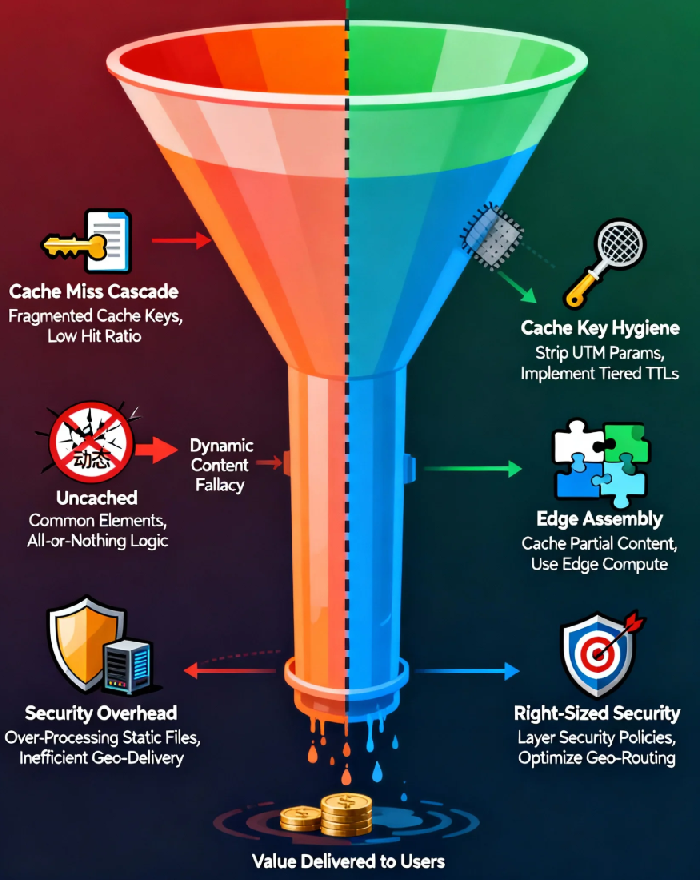
1. The Cache Miss Cascade
The cache hit ratio is the heartbeat of CDN efficiency, but it's a deceptively simple number. A 75% hit rate sounds acceptable until you realize the financial impact of the remaining 25%. Each miss triggers a cascade of expenses:
Egress from the CDN edge to your origin: This is often billed at a premium "back-to-origin" rate.
Compute cycles on your origin server to regenerate the content.
Ingress traffic back into the CDN network.
Potential database reads and application logic execution.
Now, consider the silent cost multiplier: cache fragmentation. If your site serves style.css, style.css?v=1.2.5, and style.css?sessionid=abc123 as unique objects, your hit rate plummets. You're not caching one stylesheet; you're caching hundreds of identical copies, wasting storage and memory on the edge while destroying hit rates. Studies indicate that unoptimized cache keys can inflate storage costs by up to 300% for static asset-heavy sites, turning your CDN into a wildly expensive and inefficient file server.
2. The "Dynamic Content" Fallacy
We're told dynamic content—user-specific pages, API responses, real-time data—can't be cached. This is a costly oversimplification. While the entire page may be unique, vast portions of it are often common: headers, footers, CSS frameworks, product templates, media assets.
The silent cost here is all-or-nothing thinking. By marking an entire product page as Cache-Control: private, no-store because the "Add to Cart" button is user-aware, you force the entire page—including the 2MB of hero images, CSS, and JavaScript that are identical for every visitor—to be fetched from your origin every single time. Modern edge compute capabilities (like Workers, Edge Functions) allow for dynamic assembly: caching the common 90% at the edge and stitching in the unique 10% on-demand. Not leveraging this is like chartering a cargo ship to deliver a single letter.
3. The Security and Logistics Overhead
This is the most insidious silent cost, because it feels non-negotiable. Security is paramount. But is your configuration efficient?
WAF Over-Processing: Is your Web Application Firewall performing deep packet inspection on every single JPEG and CSS file? For publicly accessible static assets, this is pure computational waste, billed to you.
Bot Management "Collateral Damage": Aggressive bot challenges can intercept legitimate traffic—including search engine crawlers. The cost? Wasted compute cycles on challenges and, more critically, potential SEO degradation which directly impacts revenue.
Inefficient Geo-Logistics: Are you using a global CDN to deliver content to a user base that's 90% concentrated in two countries? You're paying for a worldwide network but using a fraction of its capacity, a textbook inefficiency.
The ROI Lens: Framing CDN as a Performance Investment, Not a Cost
To combat silent costs, you must shift the internal narrative. Stop calling it a "CDN bill." Start calling it a "Performance Investment Report." This requires new metrics that bridge engineering and finance:
Cost-Per-Millisecond-Saved: Take your monthly CDN spend and divide it by the aggregate latency improvement versus your origin. This reveals the raw efficiency of your spend.
Cost-Per-Transaction: For an e-commerce site, how much CDN cost is associated with each completed purchase? Is it trending down as you optimize?
Cache Efficiency Ratio: Move beyond hit rate. Calculate:
(Total Bandwidth - Origin Bandwidth) / Total Bandwidth. This "bandwidth offload ratio" shows what percentage of your traffic never touches your origin, directly translating to origin infrastructure savings.
Adopting this lens uncovers the real business case for optimization. For example, finding that 40% of your "dynamic" API responses are actually cacheable for 5 seconds isn't just a technical win. If that API serves your product listing page, and you have 10,000 requests per minute, you've just avoided 10,000 unnecessary origin calls per minute. The cost savings compound: reduced cloud egress, lower compute load, and preserved database capacity.
The Path to a Silent-Cost-Free CDN
The audit begins with a single question: "Why is this request going to the origin?" Arm yourself with real user monitoring (RUM) data and your CDN's detailed logs.
Declare War on Cache Key Pollution: Implement rules to strip irrelevant query parameters (
utm_,fbclid,sessionid) from cache keys for static assets. The impact is immediate and dramatic.Implement Tiered Caching: Not all content is equal. Apply aggressive, year-long caching to hashed static assets (
main.abc123.css). Use shorter TTLs (minutes/hours) for semi-static content like blog posts. For dynamic content, explore edge-compute solutions to cache partials.Right-Size Security: Work with your security team to create a layered policy. Can static assets be served from a separate, less-processed endpoint? Can WAF rules be more granular? This isn't weakening security; it's applying it intelligently.
Negotiate and Model: With detailed efficiency data in hand, engage your CDN provider. Show them your optimized bandwidth offload ratio. You are no longer just a source of traffic; you are an efficient, valuable partner. This data is leverage for better pricing tiers.
That substantial line item on your cloud bill doesn't have to be a source of quiet resignation. It can be one of your most powerful levers for efficiency. The silent cost isn't just wasted money; it's a symbol of untapped potential—potential for faster experiences, lower operational overhead, and a more resilient architecture.
The goal isn't to slash your CDN spend to zero. It's to ensure that every dollar you spend is actively purchasing performance, resilience, or value for your users. It's about transforming the CDN from a background utility into a strategic, measurable asset. Open your last bill. Look at the number. And instead of asking "Can we afford this?", start asking the more revealing question: "What did we actually get for it?" The journey to an answer begins with that simple, uncomfortable shift.