Why Your CDN Node Seems Close, Yet Your Users Experience Slow Speeds?
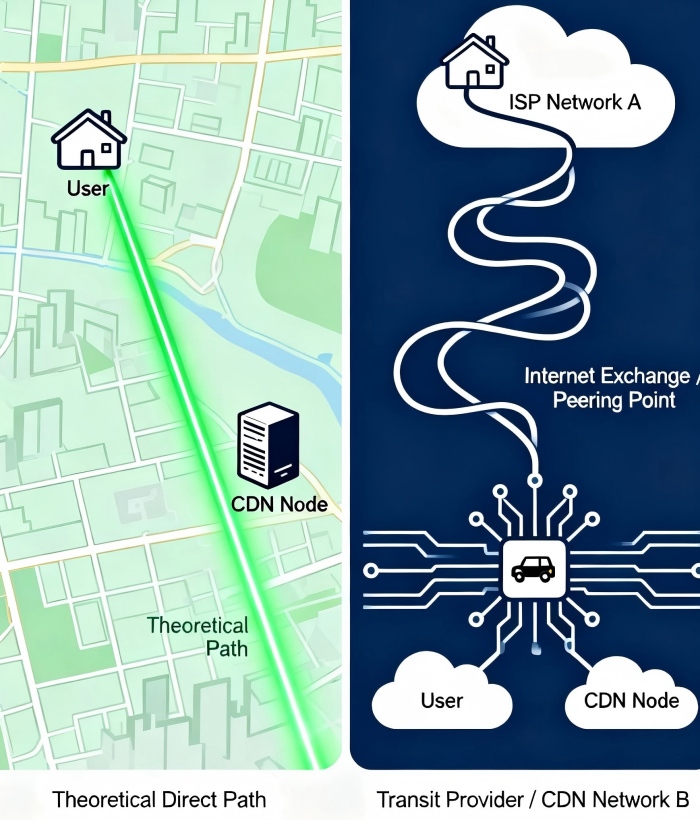
The map on your CDN dashboard tells a comforting story. A glowing dot representing a user in Frankfurt sits neatly atop another dot representing your CDN node in Frankfurt. The distance reads a crisp "5 km." Your configuration is textbook, the node is optimally located, and yet, the performance charts for that user tell a different, frustrating tale: a Time to First Byte (TTFB) of 452ms and a full page load crawling past 3 seconds. You refresh the map, doubting your eyes. How can something so close feel so slow?
You're not misreading the map. You're experiencing one of the most pervasive and misunderstood illusions in web performance: the Proximity Fallacy. Industry data reveals a jarring disconnect: in over 40% of CDN implementations, significant user segments within the nominal coverage area of a node experience latency 5 to 10 times higher than the theoretical optimum. The green checkmark on your "Node Health" dashboard is not lying; it's just measuring the wrong thing. It confirms the server is up, not that the path to your user is clear.
Let's move beyond the dashboard and talk about what's really happening. The truth is, the internet isn't a flat, open field where data travels in straight lines. It's a layered, negotiated, and often congested ecosystem of networks. The physical distance is almost irrelevant compared to the logical distance—the convoluted, unpredictable journey your data packet must take.
The Illusion of the Map: When "Close" is a Network Lie
That comforting map in your CDN provider's console is a gross oversimplification. It plots IP to geographic location, but it knows nothing of the terrain between them. The critical insight here is that physical proximity does not guarantee network adjacency.
Think of it like city streets. Two buildings might be 100 meters apart in a straight line, but if a river, a railway, and a one-way system lie between them, the actual drive is 2 kilometers. On the internet, your data packet faces "rivers" and "one-way systems" called Autonomous Systems (AS)—the massive networks operated by carriers like Deutsche Telekom, Verizon, or China Telecom.
When your user is on AS 1234 (e.g., a local ISP) and your pristine CDN node sits in AS 5678 (your CDN provider's network), the packet must cross a "border" at an Internet Exchange Point (IXP) or via a private peering link. These borders are the real choke points. If the peering link between AS 1234 and AS 5678 in Frankfurt is congested—or worse, if traffic is routed via a cheaper, uncongested link through Amsterdam—your user's 5km request just took a 500km detour. This is BGP-driven detouring, and it’s mostly invisible to your CDN’s health check.
The Three Hidden Gaps Between Your Node and Your User
The slowdown isn't caused by one thing; it's the compound effect of gaps in the delivery chain. Let's trace the journey and find where the time is being stolen.
1. The Discovery Gap: The Misleading Compass (DNS & Anycast Routing)
The first step is finding the node. When a user types your URL, their resolver (like their ISP's DNS or Google's 8.8.8.8) asks, "Where is assets.yoursite.com?" Your CDN's Anycast network proudly answers, "I'm closest!" and returns an IP address.
Here's the first surprise: 'Closest to whom?' Anycast routes based on BGP distance to the recursive DNS resolver, not the end user. If a user in Berlin is using their ISP's DNS resolver in Munich, they'll be directed to the CDN node optimal for Munich, not Berlin. This "resolver-based routing" mismatch is endemic. Studies suggest it affects 15-25% of global users, silently adding 30-100ms of unnecessary latency before a single byte is requested.
2. The Transit Gap: The Multi-Carrier Maze (The Peering Problem)
Once the IP is known, the TCP connection begins. This is where the Proximity Fallacy hits hardest. Your user's last-mile provider (e.g., a cable company) must hand off the traffic to your CDN's network. This handoff happens at a peering point.
The speed here depends entirely on the business relationship between the two networks. Is it a "settlement-free" peer (often capacity-limited)? Or a paid "transit" link? During peak hours, these interconnections can become severely congested, regardless of the gleaming hardware in the nearby CDN data center. A 2018 M-Lab study found that in North America, peak-time inter-provider latency was 2.4x higher than intra-provider latency. The "last mile" isn't the user's WiFi; it's often this "middle mile" between carriers.
3. The Terminal Gap: The Final, Uncontrolled Mile
The packet finally arrives at the local exchange, then to the user's home router, then via Wi-Fi to their device. This final segment is the wild west.
Wi-Fi Interference: That 5km-to-the-node is irrelevant if the user is three rooms away from their router, competing with a dozen other networks on the same channel.
Device Throttling: Modern smartphones aggressively conserve battery. A device in a low-power state may add 100-300ms of "radio wake-up time" before it can even process the incoming data. Your CDN's sub-10ms response is lost in this device-level scheduling.
Bufferbloat: Cheap home routers often have oversized buffers that fill up, causing packets to wait in line for hundreds of milliseconds before being dropped—a perverse "queuing delay" that feels like network lag.
The Mobile Layer Cake: A Special Kind of Chaos
On mobile networks, these problems are magnified and layered. The "node" might be a carrier-integrated CDN point inside the mobile provider's own network, truly close. Yet, performance can be erratic.
Why? Stateful Middleboxes. Mobile carriers deploy transparent proxies, video optimizers, and firewalls to manage their scarce spectrum. Your perfectly formatted, cached response might be intercepted, decompressed, inspected, and recompressed by the carrier's equipment, adding unpredictable latency. Furthermore, the switch from 4G to 5G, or even between cell towers, can cause a TCP connection to reset, forcing a new handshake and losing any multiplexing benefits of HTTP/2/3.
RUM: The Only Truth-Teller
You cannot fix what you cannot measure, and synthetic tests (like ping from a monitoring node) are useless for this problem. They measure the ideal, not the real. The only way to shatter the Proximity Fallacy is with Real User Monitoring (RUM).
RUM collects performance data from actual user browsers or apps. When you analyze RUM data by slicing it not just by geography, but by User ISP + Device Type + Time of Day, the hidden truths emerge.
You'll stop seeing "Frankfurt - 200ms avg." and start seeing:
"Frankfurt, ISP A, Fiber, Desktop - 22ms avg."
"Frankfurt, ISP B, Cable, Evening Peak, Mobile - 680ms avg."
"Frankfurt, ISP C, 4G, Android - 420ms avg."
That is your problem. It's not "Frankfurt." It's a specific combination of network, technology, and time. RUM reveals the specific peering link that fails at 7 PM, or the mobile carrier whose optimizers break your streaming. It moves you from guessing to knowing.
The most empowering realization for an engineer is this: you cannot fix the internet's architecture. But you can stop being fooled by it.
That glowing dot on the map is a promise, not a guarantee. The real work begins when you stop worshiping the map and start deciphering the myriad invisible paths that data actually travels. Speed isn't about coordinates; it's about understanding the economic, technical, and physical layers that separate a running server from a satisfied user.
The next time you see a perfect node alignment but poor performance, don't question your configuration first. Question the path. Look beyond the dot. The solution is rarely a closer node; it's almost always a smarter understanding of the terrain in between. Start with RUM. Let the real user's voice, drowned out by averages and maps, tell you where the road is broken. Then, and only then, can you start to build bridges where the maps show none.