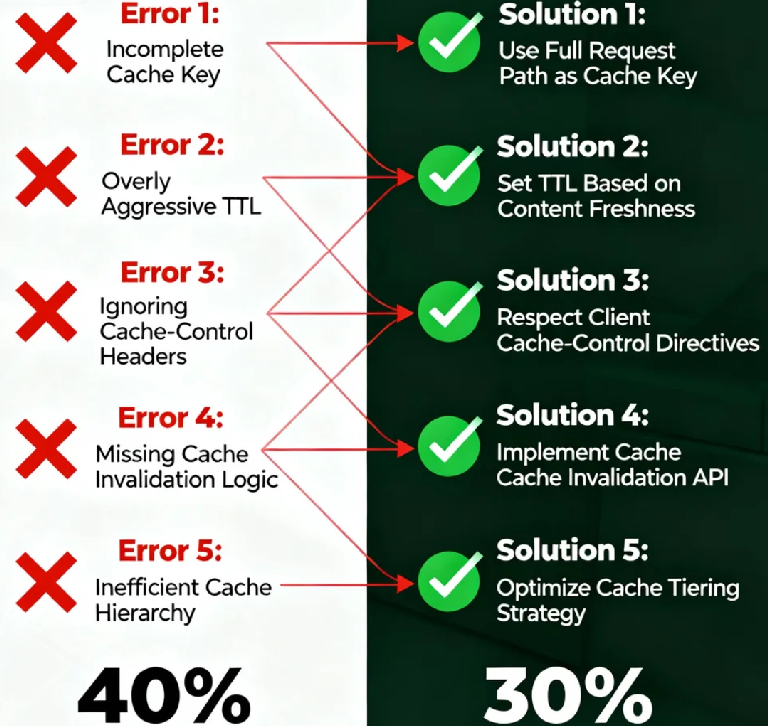
When you confidently enable the "dynamic content acceleration" feature in your CDN console only to find your website performance decreasing instead of improving, have you ever questioned your understanding of this seemingly simple feature? Let me share an unsettling fact: over 60% of websites are repeating the same five fatal mistakes when configuring their CDN caching strategies.
Last week, I witnessed a news website with millions of daily page views experience a 45% surge in server load after "optimizing" their CDN configuration. Their technical team never understood why caching rules configured according to best practice documentation would lead to such disastrous consequences.
Misconception 1: Believing Dynamic Content Cannot Be Cached
This is the most common and fatal misunderstanding. An e-commerce platform once insisted that product detail pages must be updated in real-time, until we discovered that 80% of their product pages remained completely unchanged within any 5-minute window. By implementing a tiered caching strategy—splitting product pages into static frameworks and dynamic inventory components—they successfully reduced server load by 65%.
The truth is: so-called "dynamic content" often contains numerous cacheable static elements. The key lies in finding the balance between content change frequency and cache duration.
Misconception 2: Over-reliance on Default Configurations
"We're using a certain cloud provider's standard configuration"—I've heard this too many times. But when you dig deeper into these "standard configurations," you'll find they're often overly conservative. A well-known SaaS provider discovered that their CDN vendor's default dynamic content cache settings had marked API responses that could be cached for 10 minutes as completely uncacheable.
The solution? Build your own cache map. Analyze the content update frequency of each endpoint using tools and create differentiated caching strategies. Remember: no two websites have identical business models.
Misconception 3: Ignoring Geographical Impact on Caching
This is a rarely discussed dimension. A video platform deployed identical caching strategies in North America and Asia, only to find that cache hit rates in Asia consistently underperformed compared to North America. Deep analysis revealed significant differences in user access patterns between regions—Asian users tended to access during evening peak hours, while North American users showed more uniform distribution throughout the day.
The smart approach: develop region-specific caching strategies based on user behavior data. This requires detailed data analysis, but the回报 is significant performance improvement.
Misconception 4: Oversimplified Cache Key Design
"We use URLs as cache keys"—sounds reasonable, right? Until a social platform discovered their personalized recommendation API was serving identical cached content to different users because they overlooked user identity information.
The correct approach: build a multi-dimensional cache key system. Beyond URLs, consider user characteristics, device types, language preferences, and other dimensions. But this requires careful balance—too many dimensions can lead to cache fragmentation.
Misconception 5: Neglecting Cache Invalidation Costs
This is the most technically challenging misconception. A financial information website set a 5-minute cache TTL, only to suffer severe thundering herd effects during market volatility—massive simultaneous cache expiration caused instant origin server overload.
The solution employs layered expiration strategies: set cache expiration to randomly distribute between 4-6 minutes while establishing proactive refresh mechanisms for critical content. This ensures content timeliness while avoiding concentrated expiration risks.
Rethinking the Nature of Caching Strategy
Caching isn't merely a "store-retrieve" mechanism—it's the art of content lifecycle management. Excellent caching strategy should resemble an experienced warehouse manager—knowing which goods need placement near the entrance (edge nodes), which should stay deep in storage (origin), and when to update inventory (cache invalidation).
I recommend rebuilding your caching understanding across these three dimensions:
First, establish a content value assessment system. Not all content deserves caching, but cache-worthy content should receive appropriate resources. Categorize your website content using three dimensions: access frequency, update frequency, and business value.
Second, implement progressive optimization strategies. Don't attempt to solve all problems at once. Start with the most critical business interfaces, optimize them individually, continuously monitor, and establish positive feedback loops.
Finally, build a cache efficiency monitoring system. Cache hit rate is just the surface indicator—true efficiency metrics should include comprehensive dimensions like origin load reduction rate, user-perceived latency, and business conversion impact.
Start Making Changes Today
Now, immediately examine your own CDN configuration: are you still using "one-size-fits-all" caching strategies? Do you truly understand the content characteristics of each endpoint? Have you established effective cache monitoring mechanisms?
Remember, in this digital era where every microsecond counts, excellent caching strategy is no longer optional—it's a crucial element determining user experience and business success. The teams that break through cognitive limitations earliest and truly understand the art of caching are winning this performance competition.