The Infrastructure Bill Decoded: A Complete TCO Analysis of Servers, SSL & CDN
It’s 1 AM, and the CFO and CTO of a scaling SaaS company are looking at the same report, yet seeing completely different realities. The CFO sees a clean, straightforward cloud services invoice for $45,000 a month. The CTO sees the ghosts in the machine—the additional $25,000+ per month in "phantom costs" that never appear on any bill: the developer weeks lost to inefficient deployment scripts, the customer support hours burned on misconfigurations, the revenue bled from an SSL certificate that quietly expired during peak sales.
This disconnect is the single most expensive blind spot in technology. We obsess over the sticker price—the per-GB, per-core, per-certificate cost—while ignoring the Total Cost of Ownership (TCO), the comprehensive financial truth of a technology decision from day one to its final retirement. Today, let's perform a complete forensic audit. Let's decode what your infrastructure—your servers, SSL, and CDN—truly costs.
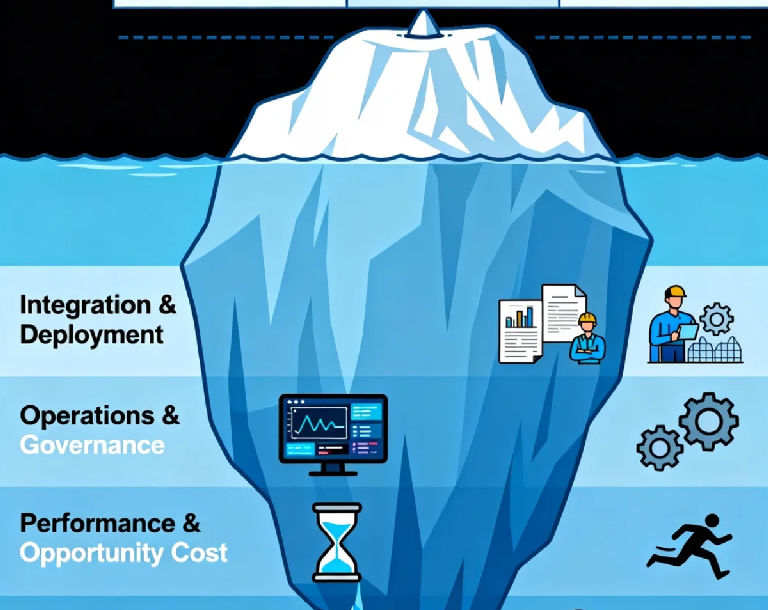
The TCO Iceberg: Why the Invoice is Just the Tip
If your monthly infrastructure bill is an iceberg, the line items you see are merely the visible tip. The real mass—and danger—lies hidden beneath the surface. Traditional thinking limits cost to procurement. True TCO analysis reveals five distinct layers:
Layer 1: The Direct Procurement Cost (The Visible Tip)
Server instance/hour or capital expenditure.
SSL certificate annual fees.
CDN data transfer and request charges.
This is the easiest to measure, yet it often constitutes only 30-50% of the actual total cost.
Layer 2: The Integration & Deployment Tax (The Setup Surcharge)
Engineering time to understand, configure, and test a new service.
Code changes to adapt your application to a new provider's quirks.
A survey of mid-market companies found that deploying a new CDN or migrating cloud providers required an average of 3.5 person-months of engineering effort. At a fully burdened rate, that's a $50,000+ "surcharge" before the service even goes live.
Layer 3: The Operations & Governance Tax (The Forever Payment)
Monitoring, alerting, troubleshooting, and patch management.
Certificate lifecycle management, key rotation, and compliance auditing.
Configuration drift control and documentation upkeep.
This is the most insidious cost sink. A self-managed solution that "saves" 15% on the monthly bill might require 1.5 dedicated FTEs to maintain, adding over $180,000 annually in personnel costs—completely obliterating the perceived savings.
Layer 4: The Performance & Opportunity Tax (The What-If Penalty)
Revenue lost from users abandoning a slow-loading page.
Transactions failed due to a misconfigured SSL handshake.
Growth opportunities missed because infrastructure couldn't scale in time.
Amazon's famous finding—that 100ms of latency costs 1% in sales—makes this calculable. If your platform does $1M in monthly sales, a poorly chosen CDN adding 300ms of latency could be silently costing you $30,000 a month.
Layer 5: The Switching & Exit Tax (The Escape Penalty)
Data egress fees to migrate out.
Architectural rework to adopt a new standard.
Contract termination penalties.
Hyperscaler cloud egress fees are the modern-day roach motel: data checks in, but it doesn't check out without a hefty bill. Migrating 500TB of data can cost $40,000 to $75,000 in fees alone.
Server TCO: You're Not Buying Cores, You're Buying Outcomes
Let's apply this to a concrete scenario: an online platform needs to serve 10,000 concurrent users.
Option A: The Public Cloud (Elastic Compute)
Direct Cost: Auto-scaling group, ~$6,500/month on average.
Integration Tax: Cloud-native adaptation, ~$55,000 (one-time).
Ops Tax: Managed platform overhead, ~0.5 FTE equivalent/month.
Opportunity Benefit: Near-infinite scale avoids blackouts during viral growth.
Exit Tax: High data egress costs, but no physical asset disposal.
Option B: The Colocated Fleet (Bare Metal)
Direct Cost: Server capex ($45,000 amortized) + colo/power = ~$3,500/month.
Integration Tax: Full-stack build-out, ~$110,000 (one-time).
Ops Tax: Minimum 1.5 dedicated FTEs for 24/7 coverage.
Opportunity Risk: Scaling requires lead time; hardware failures cause downtime.
Exit Tax: Hardware depreciation, physical decommissioning.
The 3-Year TCO Math:
Cloud:
($6.5k * 36 months) + $55k + ($15k * 36 months for Ops) = $234k + $55k + $540k = ~$829,000Bare Metal:
($3.5k * 36) + $110k + ($30k * 36 for Ops) + $45k capex = $126k + $110k + $1.08M + $45k = ~$1,361,000
The raw numbers tell a startling story: the "cheaper" bare-metal option has a 60% higher 3-year TCO. The difference is almost entirely in Layer 3: the operational burden. This analysis forces a paradigm shift: You are not procuring hardware; you are procuring a service level outcome. The cloud premium is largely a payment to transfer operational risk and complexity.
SSL/TLS TCO: The Price of Trust, Beyond the Certificate Fee
Comparing SSL certificate prices is like comparing the price of door locks without considering the cost of the security guard, the alarm system, and the insurance.
The Management Complexity Cost:
An enterprise managing 200 individual domain-validated (DV) certificates faces a constant renewal treadmill. Each certificate requires attention—validation, deployment, monitoring—averaging 2 hours of administrative work annually. That's 400 hours, or $20,000+ in annualized labor, just to stay compliant.
Consolidating to a single multi-domain or wildcard certificate slashes this overhead but increases initial complexity and creates a single point of failure.
The Security Incident Cost:
The average certificate expiry incident causes 4.2 hours of outage. For a business generating $10,000/hour in revenue, that's a direct $42,000 loss, plus brand damage.
Here's the counterintuitive part: The more expensive Extended Validation (EV) certificate, while offering no stronger encryption, can be a cost-saving tool. In finance and high-trust B2B sectors, the green address bar has been shown to increase conversion by 1-3%. On a $50M/year platform, a 1% lift is $500,000 in annual revenue—dwarfing the few thousand dollars for the certificate.
The Protocol Compliance Cost:
Mandating TLS 1.3 may break legacy clients (older IoT devices, specialized software). Supporting fallbacks or managing client upgrades requires development and testing cycles—another hidden tax on "progress."
CDN TCO: The Myth of the "Cost-Per-Gigabyte"
CDN vendors compete on pennies per GB, but this metric is a dangerous distraction from the real economic levers.
The Cache Efficiency Multiplier:
A CDN with an 88% cache-hit rate sends 12% of requests back to your origin. If your monthly CDN traffic is 500TB, that's 60TB of expensive origin traffic.
By optimizing cache rules—making static assets truly immutable, implementing smarter API caching—you might boost the hit rate to 95%. The 7% improvement reduces origin traffic by ~35TB. At $0.085/GB for premium origin bandwidth, that's a $2,500+ monthly saving that goes straight to the bottom line. This optimization is often worth more than shopping for a $0.001/GB cheaper provider.
The Configuration Management Cost:
A sophisticated CDN setup involves dozens of rules: cache behaviors, security WAF policies, edge redirects, bot management. Each is a potential point of failure. The labor to audit, test, and maintain this rule set before a major marketing campaign is a real, recurring operational expense.
The Business Performance Differential:
Provider A offers a 95ms global latency for $X/TB. Provider B offers 80ms for 20% more. Is it worth it?
The answer lies not in the bill, but in your own A/B testing data. If your tests show that 15ms improvement drives a 0.15% increase in conversion for your $20M/year e-commerce site, that's $30,000 in annual incremental revenue. If the premium for Provider B is less than $30k/year, it's not an expense—it's an investment with a clear ROI.
The Synergy Discount: When 1+1+1 < 3
The deepest TCO savings come not from optimizing components in isolation, but from engineering their synergy.
Use the CDN to Shrink the Server Bill:
Before: A powerful, expensive origin server cluster handles all requests.
Synergy: Aggressive CDN caching and edge logic (like simple API responses) intercept 85% of requests. The origin can be downsized to a smaller, cheaper footprint. The combined cost of the smaller origin + robust CDN is lower than the original monolithic server cost, and global performance improves.
Use Smart SSL to Reduce Computational Load:
Before: All domains, even static asset subdomains, use the same strong (but computationally heavy) cipher suites.
Synergy: Static content domains use faster, modern cipher suites. Dynamic API domains use the strongest security. This strategic segmentation reduces overall SSL/TLS handshake CPU load on the origin by 20-30%, allowing it to serve more users with the same hardware.
Your Four-Step TCO Transparency Framework
Knowledge is useless without action. Implement this now:
The TCO Discovery Sprint (1 Week): Assemble a cross-functional team (Engineering, Finance, Product). For your top three infrastructure services, whiteboard all five cost layers. Use tools like Harness or CloudHealth for cloud cost visibility, but manually account for the human hours in your ticketing and project management systems.
Build "Cost Causation" Maps: Don't just list costs; connect them. Create diagrams showing: "Poor cache policy -> High origin load -> Auto-scaling triggers -> Higher cloud bill + engineering alert fatigue." This reveals the root causes of spending, not just the symptoms.
Run Sensitivity Analyses: Model "what-if" scenarios using a spreadsheet.
What if our traffic grows 200% next year?
What if we need to migrate providers due to a compliance requirement?
What if the salary for a DevOps engineer increases by 25%?
These models expose which cost layers are most volatile and where your architecture is fragile.Create an Optimization Roadmap: Categorize actions:
Quick Wins (Next 30 Days): Fix egregious cache misconfigurations; automate one certificate renewal.
Strategic Shifts (Next Quarter): Renegotiate vendor contracts with your new TCO data; pilot a more efficient CDN for a non-critical property.
Architectural Evolutions (Next Year): Plan a move to a more cost-efficient compute model (e.g., from pure VMs to a mix of VMs and serverless).
When that CFO and CTO finished their TCO analysis, they didn't just cut costs. They made a series of intentional, strategic investments. They increased spending on automation software to drastically reduce operational toil. They chose a more expensive, intelligent CDN that lowered their overall origin bandwidth bill. They bought a premium support plan to eliminate multi-day troubleshooting dead-ends.
This is the ultimate revelation of TCO thinking: True cost optimization is not about spending less money; it's about spending money more intelligently to buy better outcomes. It transforms your infrastructure from a bloated cost center into a finely tuned competitive engine. It allows you to shift resources from "keeping the lights on" to "building what's next."
Stop just paying the bill. Start understanding it. The moment you see the complete iceberg—not just its tip—is the moment you gain the power to navigate it.