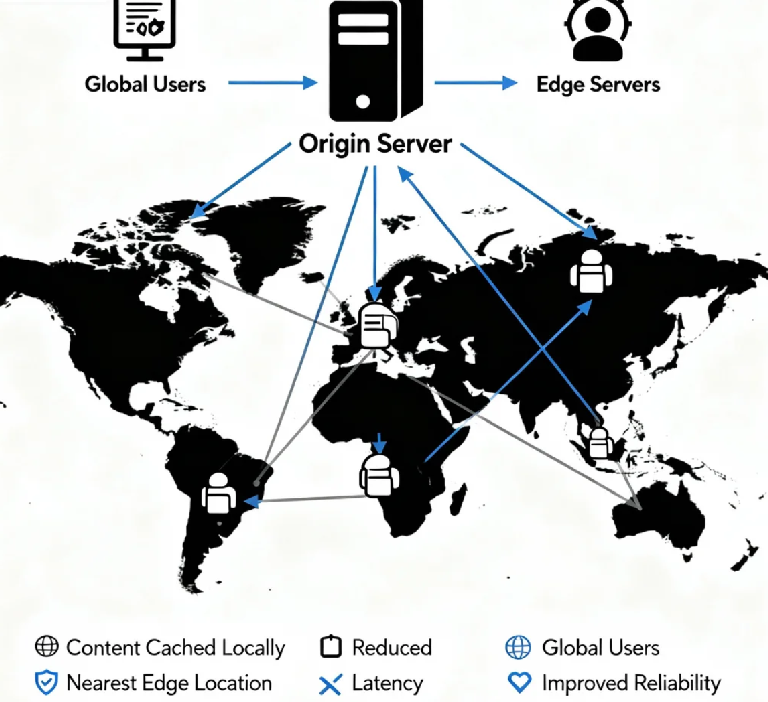
Look, I get it. You've got a powerful server, your code is clean, and you've followed every performance checklist. Yet, somewhere between your data center and your user's screen, your website turns sluggish. The culprit isn't always what you're looking at; it's often what you're looking through—the vast, unpredictable network in between. The single most effective solution to this invisible problem is something you might be underestimating: a properly configured Content Delivery Network (CDN).
Many still view a CDN as a luxury for media giants or a tool solely for static content. That's a myth I want to dismantle. A modern CDN is the fundamental architecture that bridges the physical distance between your server and your global audience, turning a fragile, long-distance connection into a robust, local delivery system. Let's talk about why it's not just an accelerator, but a critical component of your site's reliability, security, and bottom line.
The Hidden Bottleneck: It's Not Your Server, It's the Journey
When a user in Paris tries to load an image from your server in Singapore, the request doesn't travel in a straight line. It hops across dozens of routers through various internet service providers (ISPs), crossing continents and oceans. Each hop adds milliseconds of latency. A typical webpage requires 80 to 120 such requests to fully load. This process is susceptible to "network jitter"—unpredictable delays and packet loss caused by congestion, even on otherwise healthy connections.
This is the first counterintuitive truth: your website can be locally fast and globally slow. You might test it from your office and see blazing speeds, while a user halfway around the world experiences a frustrating crawl. The problem isn't your server's processing power; it's the laws of physics and the chaos of the public internet. The core value of a CDN is to minimize this journey. By caching your content on a network of distributed "edge servers" positioned around the world, the CDN ensures that user in Paris gets the image from a server in Frankfurt or Paris itself, not from Singapore. The data travels a fraction of the distance, slashing latency and bypassing congested international routes.
Beyond Speed: The Multidimensional Value of a Modern CDN
Understanding a CDN only as a speed tool is like understanding a car only as a seat. Its real value is multidimensional.
1. The Unexpected Protector: Security and Resilience
Your origin server's IP address is a hidden treasure; once exposed, it becomes a target for direct attacks. A CDN acts as a shield. It hides your origin IP, absorbing traffic and filtering it through a global network before it ever reaches your server. This distributed shield is exceptionally effective at mitigating Distributed Denial of Service (DDoS) attacks, which aim to overwhelm your server with traffic. The attack hits the CDN's vast, scaled infrastructure instead of your single origin, and malicious traffic can be scrubbed.
Furthermore, a CDN provides redundancy. If one edge node has an issue, the intelligent routing system—often using technologies like Anycast—simply directs traffic to the next optimal node. This means hardware failures or localized network problems don't take your entire site offline for users in that region.
2. The Silent Accountant: Cost and Load Management
Here's a surprising financial perspective: a CDN can save you money on your hosting bill. How? By serving cached content from the edge, it dramatically reduces the amount of data that needs to be pulled from your origin server. This "offloading" means you can handle the same amount of global traffic with less origin bandwidth, potentially allowing for a smaller, more cost-effective hosting plan. For sites with heavy static assets (images, CSS, JavaScript, videos), the bandwidth savings alone can justify the CDN cost.
3. The Modern Enabler: Core Web Vitals and User Experience
Search engines, particularly Google, now explicitly use page experience as a ranking factor through Core Web Vitals metrics like Largest Contentful Paint (LCP) and Cumulative Layout Shift (CLS). A slow-loading site hurts your SEO.
A CDN directly improves these metrics by delivering content faster and more reliably. Faster sites also have lower bounce rates and higher conversion rates. Data suggests that a 1-second delay in page load can lead to a 7% reduction in conversions. A CDN isn't just an IT tool; it's a revenue protection tool.
Choosing and Implementing: It's About Strategy, Not Just Technology
Not all CDNs are created equal, and implementation is key. Here's how to think strategically:
The "Dynamic Content" Misconception
A common hesitation is: "My site is dynamic/user-specific, so a CDN won't help." This is outdated. Modern CDNs excel at dynamic acceleration. While your personalized user dashboard can't be cached for everyone, the CDN optimizes the path the data takes. It uses intelligent routing systems that continuously monitor global network conditions—latency, packet loss, congestion—and choose the fastest, most stable route for each request in real-time. This can drastically speed up API calls, database queries, and live updates.
The Critical Configuration: Caching Rules
The power of a CDN is harnessed through its caching rules. A misconfigured cache can cause more harm than good, serving stale content or failing to cache at all.
Static Assets (Images, CSS, JS, Fonts): These should be cached aggressively, with a Time-To-Live (TTL) of weeks or even months. Use cache-busting techniques (like adding a version number to the filename) when you update them.
HTML Pages: For blogs or news sites, a shorter TTL (minutes or hours) is appropriate. For highly dynamic pages, you might use a "stale-while-revalidate" policy, which serves a slightly old version while fetching a fresh one in the background.
Truly Personal/Private Content: Set rules to bypass the cache entirely for these paths (e.g.,
/account/,/checkout/).
A Practical Starter Plan
Audit Your Content: Use your site's analytics to identify your top 20 most-visited pages and their largest assets (images, videos).
Start with a Simple Rule: Configure your CDN to cache all images, CSS, and JavaScript files from these pages with a 30-day TTL.
Implement a Performance Budget: Use free tools like Google PageSpeed Insights or WebPageTest. Run a test before and after enabling the CDN. Aim for concrete improvements in LCP and fully loaded time.
Monitor and Iterate: Check your CDN's analytics dashboard. What's the cache hit rate? Is traffic being distributed well? Tweak your rules based on data.
The internet wasn't built for the instant, global, media-rich experiences we expect today. The CDN is the architectural patch that makes the modern web possible. It's the system that quietly ensures a shopper in Tokyo, a student in Berlin, and a developer in San Francisco all get a fast, secure, and reliable experience from your single server.
Moving to a CDN isn't just a technical optimization; it's a shift in mindset. It's acknowledging that your website's performance is defined not by its peak capability in isolation, but by its consistent delivery under the messy, real-world conditions of the global network. It’s about choosing to build a robust, distributed presence rather than hoping users will find their way to your one digital doorstep. In the end, a CDN doesn't just make your site faster—it makes it fundamentally more professional, resilient, and ready for the world.