Beyond the Padlock: Decoding DV, OV, and EV SSL Certificates for Real Performance & Trust
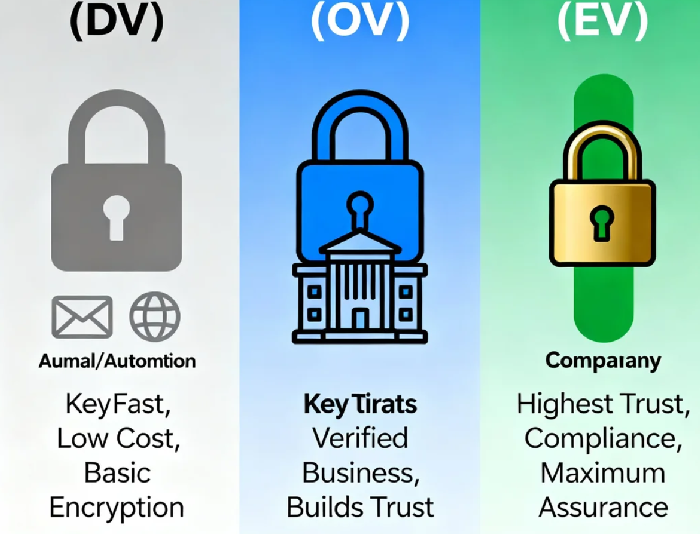
Alright, let’s cut through the noise. You see the padlock in your browser every day. Your IT team insists you have one. But if you think choosing between a DV, OV, or EV SSL certificate is just about picking a price tag or getting a fancier security icon, you’re missing the point entirely. In reality, you’re making a critical investment in your company's digital trust infrastructure at a time when the foundational rules are being rewritten.
I want you to consider something counterintuitive: the most common choice is often the riskiest. According to a 2025 industry landscape report, a staggering 73.5% of all SSL certificates in use are Domain Validated (DV) certificates. These are the quick, automated, low-cost options. Meanwhile, Extended Validation (EV) certificates, the ones with the famous green bar, make up less than 2%. The market is flooded with basic encryption, but starved of verified identity. This isn't just an IT trend; it’s a vulnerability. Cybercriminals love this imbalance because they can easily obtain a DV certificate for a phishing site, making it look secure with that same padlock, to impersonate your brand and deceive your customers.
The game is changing, and fast. The industry governing body has mandated that SSL certificate lifespans will plummet from the current standard down to just 47 days by 2029, with an intermediate step to 200 days in 2026. We’re moving from an era of "set it and forget it" to a future where your certificates will need near-continuous renewal. This seismic shift turns certificate management from a yearly administrative task into a core operational security function. The companies that will thrive are those that stop seeing certificates as a commodity and start strategizing them as a dynamic component of performance and trust.
The Trust Spectrum: More Than Just a Padlock
So, what are you actually buying? Let's move beyond the sales brochures.
DV (Domain Validation): The Baseline Commodity. A DV certificate answers one question: "Does the applicant control this domain?" It’s an automated check, often done via email, and can be issued in minutes. Its sole job is to enable HTTPS and turn the "Not Secure" warning into a padlock. It provides encryption, but zero information about who is behind the website. It’s perfect for a personal blog or an internal test server. For any commercial entity, it’s merely the absolute minimum—like putting a lock on a post office box without verifying who rented it. Relying on it for customer-facing business is a classic "validation mismatch," where the level of trust presented (a secure-looking site) dangerously outweighs the actual verification performed (almost none).
OV (Organization Validation): The Identity Anchor. This is where trust begins for businesses. An OV certificate requires a rigorous, human-led vetting process by the Certificate Authority (CA). They verify your organization's legal, physical, and operational existence using official third-party databases. This process takes 1-3 days. The technical magic is that your verified company name is embedded within the certificate itself. While browsers no longer show this prominently in the address bar, it's visible to users who click the padlock and is critically visible to other machines—like search engine crawlers and business partners' systems. An OV certificate declares, "This secure connection is provided by a verified, legitimate company." It’s the standard for corporate websites, SaaS platforms, and any site where establishing entity credibility is non-negotiable.
EV (Extended Validation): The Gold Standard for Deliberate Trust. EV is the most rigorous audit. The CA conducts an enhanced verification process, checking government records, legal documents, and even performing direct contact checks. It’s the digital equivalent of a notarized document. While the distinctive green address bar is less common in modern browsers, the value of EV has evolved, not diminished. It provides the highest level of assurance in the certificate's metadata, which is paramount for compliance in regulated industries like finance, healthcare, and e-commerce. It’s a powerful signal in high-stakes transactions, where reducing user friction and doubt can directly impact conversion rates.
The Hidden Levers: Performance, Compliance, and the Coming Algorithmic Storm
Choosing a certificate type is the first decision. To truly build a resilient system, you must peer under the hood at two more layers: the cryptographic engine and the management framework.
1. The Performance Engine: ECC vs. RSA.
Not all encryption is created equal. The traditional RSA algorithm is like a reliable, sturdy truck. The newer Elliptic Curve Cryptography (ECC) is like a sports car—it provides equal or greater security with significantly shorter keys. This translates to tangible speed: ECC can improve TLS handshake speed by up to 40% compared to RSA. For mobile users or high-traffic global platforms, this means faster page loads and a smoother user experience. When evaluating certificates, especially for performance-sensitive applications, opting for one that supports ECC is no longer a luxury; it’s a performance best practice.
2. The Compliance and Future-Proofing Maze.
Your industry dictates your needs. The Payment Card Industry Data Security Standard (PCI DSS) has specific requirements for certificate strength. In China, the Multi-level Protection Scheme 2.0 may mandate the use of domestic cryptographic algorithms (SM2/SM3/SM4). Looking over the horizon, a new storm is brewing: quantum computing. Current encryption algorithms, both RSA and ECC, are theoretically vulnerable to future quantum attacks. The industry is already preparing for a migration to Post-Quantum Cryptography (PQC). Forward-thinking organizations are now considering what "crypto-agility" looks like—the ability to swiftly update cryptographic algorithms without disrupting operations. Your certificate provider and management strategy must be ready for this transition.
The Impending Crisis and the Path to "Autopilot"
This brings us to the central, urgent challenge hinted at earlier: the 47-day certificate lifespan. Managing certificates manually in this new world is a recipe for disaster. A single expired certificate can cause a major application, payment gateway, or email system to fail catastrophically. Studies show that 37% of companies have already experienced an outage due to a certificate issue.
The solution is not more spreadsheets or calendar alerts. It’s automation. Modern certificate management platforms can handle the entire lifecycle—discovery, provisioning, renewal, deployment, and revocation—autonomously. In the face of shortening lifespans and increasing complexity, moving to an automated system is akin to upgrading from manual driving to a reliable "autopilot" for your digital trust framework. This is the only way to eliminate human error, prevent outages, and free your team to focus on strategic work.
A Strategic Blueprint for the New Era
So, where do you start? Ditch the old "DV for cheap, EV for fancy" mindset. Follow this decision framework:
Map Trust to Function: What does this digital asset do?
Corporate website, blog, or brochureware? An OV certificate is the professional standard. It anchors your online presence to your legal identity.
E-commerce checkout, login portal, or financial service? This is high-trust territory. An EV certificate provides the maximum assurance for you and your customers.
Demand Technical Excellence: For any public-facing, performance-critical asset, insist on ECC support for faster handshakes. Choose a provider with a robust roadmap for Post-Quantum Cryptography readiness.
Architect for Automation Immediately: Regardless of certificate type, your next step must be to evaluate and implement an automated certificate lifecycle management solution. This is no longer an IT efficiency project; it's a business continuity imperative.
The padlock was never the end goal. It was just the most visible signpost on a much longer road toward establishing and maintaining digital trust. That road is now being repaved with stricter rules and shorter timelines. The choice before you isn't just which certificate to buy this year. It's whether you will build a fragile, manual system destined for failure, or a resilient, automated trust infrastructure designed for the future. The true performance metric won't be your page load speed alone, but the unwavering reliability and security your users can count on, every single day. That’s the trust that goes far beyond the padlock.