The Lag Killer: The Ultimate Guide to Choosing a Professional CDN for Online Games
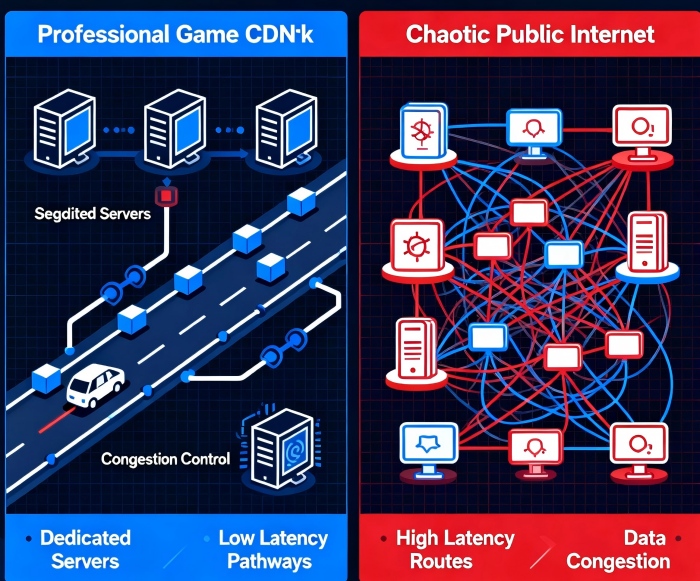
Let's be honest. You've spent years perfecting your game's mechanics, poured your soul into its art, and fine-tuned its balance. Yet, in that crucial moment—the final shot, the epic raid wipe, the last-second capture—it's not your design that fails. It's the unseen, sprawling chaos of the public internet. A player's connection stutters, a packet gets lost in a congested router halfway across the world, and frustration replaces triumph. Your masterpiece is held hostage by network latency.
Here's the uncomfortable truth most developers learn too late: using a generic CDN for your game is like using a cargo ship for a Formula 1 race. It moves assets, yes, but it's built for an entirely different purpose—bulk, static content delivery—not the nanosecond-sensitive, real-time dialogue of modern online gaming. The wrong infrastructure doesn't just add latency; it introduces unpredictable jitter, turns minor routing issues into catastrophic lag spikes, and leaves you vulnerable to attacks that can erase your hard-won player base overnight.
This isn't just about being "faster." It's about building a predictable, sovereign network layer for your game's real-time conversations. This guide will dissect why a professional, game-aware CDN is the most critical back-end decision you'll make after choosing your game engine.
The Multi-Headed Beast: Understanding Real Latency
Before we solve lag, we must understand its true nature. Latency isn't just distance.
The Physics Problem (Propagation Latency): This is the simple speed-of-light limit. Data from New York to London takes about 28ms one-way. You can't cheat physics, but you can strategically place your game servers and logic to minimize these unavoidable trips.
The Silent Killer (Jitter): This is latency's unpredictable twin. Your average ping might be 50ms, but if packets arrive in clumps—20ms, then 80ms, then 30ms—the game feels choppy and unreliable. Jitter is what makes character movement "rubbery" and makes precise timing impossible. A standard CDN, optimized for throughput, often ignores jitter. A game CDN is engineered to eliminate it.
The Routing Maze: Data doesn't travel in a straight line. It passes through internet exchange points and Internet Service Provider networks. A suboptimal route can double or triple transit times. Professional CDNs don't just have points of presence; they have intelligent, software-defined networks that continuously probe for the best, least congested path in real-time.
The Protocol Mismatch: HTTP/HTTPS, the workhorses of the web CDN world, are built for reliability, not speed. They involve multiple handshakes and acknowledgments. Games, especially fast-paced ones, rely on UDP or WebSocket for a reason—they prioritize speed and timeliness, accepting that some data loss is preferable to waiting for a retransmission. A game CDN optimizes for these protocols at its core.
Beyond Cache: The Five Pillars of a Game-First CDN
A professional CDN for gaming moves far beyond the concept of caching static images. It becomes an active, intelligent participant in your game's data flow.
1. Intelligent, Real-Time Routing & Anycast
This is the first major divergence. A generic CDN typically uses DNS-based routing, sending a player to the nearest physical server. That's fine for a website. For a game, "nearest" isn't always "fastest." A game CDN employs Anycast routing for critical real-time traffic. With Anycast, your game server IP is advertised from dozens of locations globally. A player's connection is automatically drawn to the topologically nearest entry point by the internet's own routing protocols (BGP), shaving off precious milliseconds from the initial connection. Inside the CDN's private backbone, traffic is then whisked along optimal paths to your actual game server, avoiding public internet congestion entirely.
2. Protocol Optimization at the Edge
A game CDN doesn't just pass through your UDP or WebSocket traffic; it understands it. It can:
Accelerate Connection Establishment: Reduce the time to set up secure (DTLS) or efficient (QUIC) connections.
Mitigate Packet Loss: Implement forward error correction or intelligent packet reordering at the edge to smooth over minor network blips before the player feels them.
Traffic Shaping: Prioritize game-state update packets over less critical asset download packets on the same connection, ensuring the most important data gets through first.
3. Integrated DDoS Protection: The Invisible Shield
Online games are prime targets for DDoS attacks—from disgruntled players to rival studios. A volumetric attack can completely saturate your server's connection. A professional game CDN acts as a distributed shield.
Absorption Capacity: Its vast, distributed network can absorb attack traffic that would overwhelm a single server or data center.
Intelligent Scrubbing: Attack traffic is identified and filtered out at the edge, often within seconds, while legitimate player traffic is allowed through. The game server only ever sees clean traffic. This isn't an add-on; it's built into the fabric of the network.
4. Global Consistency and State Synchronization
For globally distributed games, ensuring a fair and consistent experience is a nightmare. A player in Sydney fighting a player in Berlin shouldn't feel like they're playing different games. Advanced game CDNs help tackle this through:
Network Telemetry: Providing you with real-time data on latency and packet loss between all your server regions and your players. This data is gold for matchmaking—you can ensure players are matched into servers that provide a comparable latency experience for all.
Predictive Pre-positioning: For certain game types, non-critical assets or even world-state deltas can be pre-positioned at edge locations closer to players who are likely to need them, based on gameplay patterns.
5. Developer-Centric Tooling and Visibility
You can't manage what you can't see. A black-box solution is useless. A professional service provides:
Real-Time Dashboards: Visualize global player latency, jitter, and packet loss.
Alerts & Diagnostics: Get immediate notifications of regional issues and tools to diagnose if a problem is with the player's ISP, the CDN, or your own servers.
API-First Design: Programmatically adjust configurations, pull metrics into your own monitoring, and automate scaling.
The Selection Framework: Asking the Right Questions
Don't just compare price-per-gigabyte. When evaluating a professional game CDN, grill them on these points:
"How do you handle real-time protocol optimization?" Demand specifics on UDP, WebSocket, and QUIC support. Do they have custom tuning or just basic passthrough?
"What is your global anycast footprint for game traffic?" A map with dots isn't enough. Ask about the capacity and interconnectivity of their private backbone.
"Walk me through your DDoS mitigation process for a game-specific attack." The answer should be immediate, automated, and not involve a support ticket.
"What tools do you provide for matchmaking and latency monitoring?" They should offer more than basic logs—think APIs for latency-based server selection.
"What is your stance on 'edging' game logic?" Some are exploring edge compute for things like hit validation. Understand their vision and roadmap.
The Future is at the Edge: Beyond Simple Delivery
The frontier of game CDNs is converging with edge computing. Imagine running small, safe pieces of deterministic game logic—like hit detection, proximity checks, or non-player character AI—on the CDN node itself. This would reduce round-trips to the main game server to near zero for those actions, unlocking a new tier of responsiveness for genres like fighting games or competitive shooters. The leading game CDNs are already experimenting with this paradigm.
The Ultimate Win Condition
Choosing a professional CDN is not an IT cost; it's a direct investment in player satisfaction, retention, and your game's reputation. In an era where a single viral clip of game-breaking lag can damage launches, the network is your silent, foundational gameplay feature.
The goal is not just to reduce the average ping number on a stats screen. It's to make the network itself disappear—to create an experience so consistent and responsive that your players are free to be fully immersed in the world you built, their actions flowing seamlessly into the game universe without a whisper of obstruction. That is the true art of the lag killer: building not just a faster pipe, but a trustworthy stage upon which your game's magic can reliably perform, for every single player, everywhere in the world.
When you achieve that, you're no longer just fighting latency. You're building trust. And in the world of online gaming, trust is the currency that builds communities, sustains live services, and turns players into advocates. That is the real victory a professional CDN delivers.