Beyond Speed: Why a Professional Game CDN Must Be a High-Defense CDN
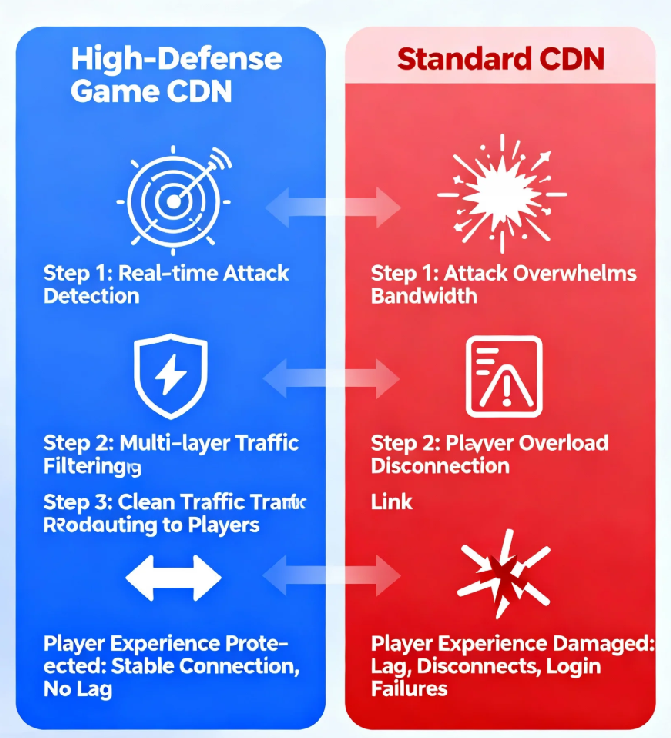
Let's talk about the quiet killer of live service games. It's not a bad meta, a controversial patch, or a competitor's launch. It's the silent, sudden moment when your beautifully optimized game—with its 35ms global latency, perfect matchmaking, and pristine netcode—becomes unplayable. The dashboard is a sea of red. Player connections plummet. Your community channels erupt with complaints about lag and disconnections. You haven't been hacked; your code is fine. Your infrastructure is under a Distributed Denial of Service (DDoS) attack, and your network was built for speed, not war.
Here’s a sobering statistic that reframes the entire conversation: the gaming industry endured over 42% of all DDoS attacks globally in 2023. That's more than finance, e-commerce, and enterprise services combined. The average top-tier online game faces over 20 meaningful attack attempts per week. But the modern threat isn't just about brute force. Attackers have evolved into tactical saboteurs, executing "low-and-slow" attacks during your most critical windows—a new season launch, a major tournament final—causing just enough disruption to destroy competitive integrity and shatter player trust, leading directly to churn.
This leads us to the fundamental, counter-intuitive truth of modern game operations: network acceleration and security are no longer separate line items; they are two inseparable functions of a single, critical system. A CDN built only for speed in today's landscape is like a race car with a Formula One engine but no seatbelts, airbags, or roll cage. It might perform beautifully on a perfect track, but the first piece of debris—the first deliberate collision—will be catastrophic. True performance is not raw velocity; it is guaranteed, resilient delivery. Without integrated high-grade defense, your speed is an illusion waiting to be shattered.
The Broken Paradigm: Why "Bolt-On" Security Fails Games
The traditional IT security model is "fortress and moat": stack defensive appliances at your data center's front door and block the bad traffic. For games, this model is fundamentally flawed due to three intrinsic conflicts.
1. The Camouflage Crisis of Game Protocols
The very protocols that make real-time gaming possible—the rapid UDP packets, constant state synchronization, and server-authoritative logic—are also the perfect camouflage for attackers. Malicious traffic can mimic legitimate game packets, launching targeted application-layer (Layer 7) attacks with minuscule bandwidth (sometimes just 1-2 Gbps) aimed at crippling your matchmaking service or login auth servers. These attacks slip under the radar of traditional volumetric (Layer 3/4) DDoS defenses. Data suggests over 60% of the most damaging and difficult-to-mitigate attacks on games are these precise, surgical strikes, not crude floods.
2. The Fatal Flaw of Origin Exposure
If your CDN's only job is to cache and route, it ultimately reveals a path back to your origin server's IP addresses. Once an attacker discovers this IP—through probing, leaks, or sheer persistence—they bypass your entire CDN's acceleration network entirely. They can direct their attack straight to your unprotected origin, rendering your beautiful global acceleration null and void. A professional high-defense CDN must employ architectural origin hiding, where your true servers are never directly addressable from the public internet. All traffic, good or bad, must be forced through the CDN's security and routing intelligence.
3. The Latency-Security Paradox (And Its Solution)
Conventionally, routing traffic through a security scrubbing center adds hops, complexity, and milliseconds—the enemy of low latency. This was the classic trade-off: security meant lag. The breakthrough of modern, integrated high-defense CDNs is the fusion of security logic into the edge-routing fabric. Threat analysis isn't a separate, subsequent step; it happens concurrently at the point of ingress. In nanoseconds, the system identifies a packet, determines its optimal performance route, and assesses its threat profile. Legitimate player traffic is shunted onto the fastest possible path, while malicious traffic is diverted to scrubbing—all without the legitimate packet ever taking a detour. This dissolves the old paradox, proving that intelligent security can be latency-neutral for your players.
The Three Pillars of a Modern High-Defense Game CDN
Today's "high-defense" capability transcends simple traffic filtering. It is an intelligent, adaptive immune system built for the unique biology of online games.
Pillar 1: Behavioral Intelligence & Zero-Trust Routing
Beyond blacklists and rate limits, the system builds a continuous behavioral baseline for your specific game. It understands normal patterns—packet sizes, request frequencies, the "conversation" between client and server. A connection from a known IP that suddenly starts sending ill-timed or malformed game-state updates is flagged instantly, even if it's using negligible bandwidth. This is coupled with a zero-trust approach, where every session is continuously and lightly validated, preventing compromised legitimate connections from becoming attack vectors.
Pillar 2: Protocol-Aware, Game-Specific Protection
This is what separates a generic DDoS mitigation service from a game-native defense system. It understands and protects the network layers of common engines (Unreal, Unity) and can identify attacks tailored to break game logic, such as:
Forged packets designed to disrupt skill-shot validation in a MOBA.
Malicious bursts of packets aimed at desynchronizing player positions in a battle royale.
Fraudulent transaction injections into an in-game economy or auction house.
By operating at this level, it can drop attack packets with surgical precision while allowing 99.99% of legitimate gameplay traffic to pass unimpeded.
Pillar 3: Global Elasticity & Economic Certainty
Attacks are ultimately a battle of resource attrition. An integrated high-defense CDN leverages a globally distributed edge network with massive, multi-terabit-per-second bandwidth capacity. Attacks are absorbed and diluted at the edge node closest to their source, never converging into a single point of failure. Crucially, leading providers operate on a clean traffic pricing model: you pay only for the bandwidth of legitimate player traffic. The potentially enormous cost of scrubbing attack traffic is borne by the network, not your operation. This provides not just technical resilience, but financial predictability—a critical factor for studio budgeting.
The Business Calculus: Security as the Foundation of Experience
Choosing an integrated solution is no longer just a technical decision; it's a core business strategy. The cost of a successful DDoS attack is multidimensional:
Direct Revenue Loss: When servers are down, in-app purchases, battle pass sales, and item shop revenue drop to zero. For a top-grossing game, this can mean tens of thousands of dollars lost per hour of downtime.
Player Trust Erosion & Support Overload: Attacks causing rollbacks or item loss trigger a flood of customer support tickets and refund requests. More damaging is the loss of player confidence. Studies indicate that after a severe outage, a game's 30-day player retention rate can drop by an average of 8-15%—a devastating long-term impact.
Irreparable Brand Damage: In the age of social media, "the servers are down" becomes a meme. That negative sentiment forms a lasting impression, creating a significant barrier to acquiring new players.
Therefore, high-defense capability is, in essence, an insurance policy for player experience and revenue. It guarantees that your massive investment in latency optimization, your meticulously planned live events, and your high-stakes esports tournaments won't be undone by a cheap, rentable attack tool.
The Future: The Autonomous Nervous System for Games
Looking ahead, the pinnacle of this technology is a network that functions as a game's "autonomous nervous system"—proactive, predictive, and self-healing.
By analyzing global threat intelligence and attack patterns, the network could pre-emptively deploy filtering rules for a newly discovered game engine vulnerability before a widespread attack even begins. It could integrate directly with game server orchestration, dynamically isolating or scaling instances in a specific region when anomalous traffic patterns are detected, ensuring service continuity.
At this stage, developers and players are freed from the underlying fear of network threats. Players experience a world that is simply, reliably there. Developers can focus entirely on creativity and community, not on infrastructure firefighting.
The Unbreakable Link
So, why must a professional game CDN be a high-defense CDN?
Because the "speed" we promise players today is no longer just a measure of milliseconds. It is a comprehensive package of availability, stability, fairness, and certainty. Real speed is built on a foundation of resilience. Acceleration without integrated security is a fragile house of cards. Defense without optimized performance is a burdensome anchor.
Investing in a professional CDN with high-defense at its core is not purchasing bandwidth and scrubbing. You are architecting the foundational layer of your game's world: a superhighway with an intelligent, impervious safety system. You are building a fortress where your community can thrive, compete, and connect—secure in the knowledge that their time and passion are protected.
In the end, this is what the technology truly serves: not just data packets, but the human experiences they carry. Ensuring every connection is both swift and secure is the deepest form of respect a creator can offer their players.