Solving SEA Latency: How Game Globalization Uses Localized CDN to Break the 60ms Barrier
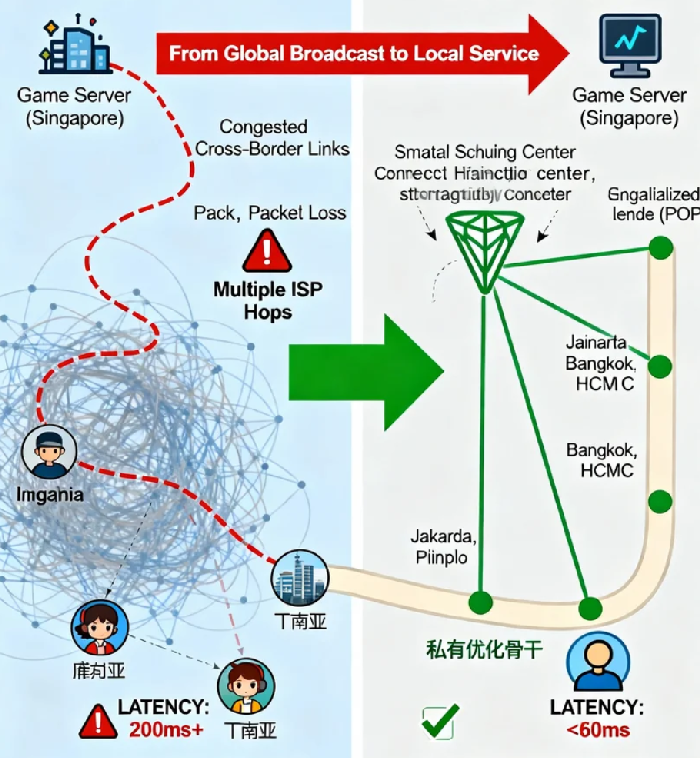
Let's be brutally honest. You've poured years into perfecting your game's mechanics, art, and balance. You launch in Southeast Asia (SEA), a market buzzing with potential, only to watch your masterpiece unravel in your community forums. The complaints aren't about your design; they're about a phantom enemy: "My character is sliding," "My skill shot fired a full second late," "The team fight looked like a slideshow." Your dashboard shows a steady, damning average latency of 180ms from Jakarta to your servers in Singapore. You've just learned the hard way that in the real-time crucible of online gaming, exceeding 100ms of latency erases competitive integrity, and anything over 150ms is a death sentence for player retention.
This isn't a failure of your core game logic. It's a defeat orchestrated in the silent, chaotic trenches of the internet's "last mile"—a journey across undersea cables, fragmented national networks, and congested cross-border links. A revealing study shows that 87% of users will abandon an app entirely if it takes more than 2 seconds to load. For real-time games, the tolerance is even lower. The path to winning in SEA isn't just about marketing or localization; it's about fundamentally re-architecting how your game connects to its players. The solution isn't merely "renting a server nearby." It's engineering a strategic, intelligent, and deeply localized Content Delivery Network (CDN) architecture designed not just to deliver data, but to preserve experience.
The 60ms Benchmark: More Physics Than Fantasy
Why 60ms? Let's start with the unchangeable: the speed of light. Data in fiber optic cables travels at roughly 200,000 km/s. The sheer physical distance from, say, North America to Singapore is about 15,000 km, which alone imposes a minimum of 75ms of propagation delay. Add network hops, carrier handoffs, and congestion, and you're easily looking at 200ms+. This is why a famous MOBA title saw its SEA player latency plummet from 460ms (using US West Coast servers) to 45ms after deploying infrastructure in Singapore, resulting in a 27% surge in player retention.
Thus, the 60ms target isn't arbitrary. It's the aggressive, achievable baseline for "fair play" in latency-sensitive genres like MOBAs, FPS, and battle royales after negotiating with physics and network geopolitics. It signifies that player traffic must be exchanged within the region, avoiding intercontinental detours at all costs.
The Architecture Revolution: From Centralized Hub to Distributed Edge
The classic model of a single, centralized server cluster serving the globe is a recipe for failure in SEA. The region's digital landscape is a patchwork: dominant local carriers in Indonesia (Telkomsel), the Philippines (PLDT), Thailand (AIS), and Vietnam (VNPT) have complex and sometimes costly interconnections. A true localized CDN transcends simple caching; it becomes a distributed edge-compute platform.
1. Intelligent Geo-Routing & The "Hot Potato" Problem
A naive CDN might route a player in Manila to the geographically closest node in Singapore. However, the internet doesn't respect maps. Traffic can be "tossed like a hot potato" between carriers, taking inefficient paths. An advanced game CDN uses Real User Monitoring (RUM) and Anycast routing to perform continuous, real-time path analysis. It doesn't just find the closest node; it finds the fastest node at that exact millisecond, dynamically steering players around congestion and outages. This can reduce routing-induced latency by up to 40% compared to static DNS-based routing.
2. Protocol Optimization for the Mobile-First Frontier
SEA is overwhelmingly mobile-first, often on unstable 4G/5G networks. The standard TCP protocol, with its rigid handshakes and congestion control, falters here, leading to jitter and packet loss. Modern game CDNs implement protocols like QUIC (over UDP). QUIC combines connection setup (0-RTT resumption) with improved congestion control, effectively turning many short TCP transactions into a single, resilient stream. In real-world tests for mobile game updates, QUIC has shown reductions in download time by 30-40% in poor network conditions, making the crucial first impression a smooth one.
3. Beyond Caching: Stateful Edges and Cost Governance
Traditional CDNs cache static assets (patches, assets). A game-savvy CDN goes further. It can host lobby services, friend lists, and leaderboards at the edge, making these high-frequency, low-data interactions feel instantaneous. More critically, it acts as a "Shield for Origin." During a major season launch, a CDN with tiered caching and request coalescing can absorb over 99% of the update traffic at the edge. This prevents your core servers from being overwhelmed, ensuring 100% uptime during peak moments, while also slashing expensive cross-border bandwidth costs by 60% or more, transforming the CDN from a cost center to a strategic asset.
Deep Localization: The Unseen Strategic Layer
In Southeast Asia, "localization" means more than language translation. It means integration into the local digital fabric.
Strategic POP Placement: While Singapore is a vital regional hub, victory depends on in-country Points of Presence (PoPs) in Jakarta, Manila, Bangkok, and Ho Chi Minh City. These PoPs establish direct, "peered" connections with major local Internet Service Providers (ISPs), bypassing the public internet's turbulence. Data shows that a player in Manila connecting to a local PoP can see latency drop from 200ms+ to under 80ms compared to a Singaporean endpoint.
Compliance and Data Sovereignty: Regulations around data are tightening across ASEAN. A distributed CDN architecture with local caching can help ensure player data stays within regional boundaries, future-proofing your game against evolving data residency laws.
Embedded Security: SEA is a high-risk zone for DDoS attacks. A globally distributed CDN provides a massive, distributed surface area to absorb and scrub attack traffic. With integrated DDoS mitigation and Web Application Firewalls (WAF) at the edge, attacks are neutralized before they ever reach your game servers, securing critical e-sports events and launch days.
Translating 60ms into Business Value
Investing in this architectural sophistication pays direct dividends on your core metrics:
Retention and Revenue: Latency isn't just a number; it's a feeling. Reducing ping from 200ms to 50ms can directly increase average session length by up to 42% and lift in-game purchase conversion rates by nearly 19%. In the social media age, a smooth experience is your most potent marketing.
Operational Resilience: An intelligent, automated network provides a buffer against regional outages and traffic spikes. This liberates your ops team from constant firefighting, allowing them to focus on community and live events.
The Foundation for Scalability: A mature SEA CDN blueprint is a reusable template. The architectural lessons and partner ecosystem built here become the launchpad for successful entries into other complex, high-growth markets like Latin America or the Middle East.
The Final Barrier is Cultural
Ultimately, breaking the 60ms barrier with a localized CDN is about more than optimizing packets. It's about constructing a regional service fabric that respects the player's context. It's what allows a squad in Jakarta, a duo in Bangkok, and a solo queue player in Hanoi to meet on a virtual battlefield with equal footing, dignity, and immediacy.
This seamless experience is the deepest, most profound form of localization—one that no amount of translated text or regionalized art can replicate. When the technical friction disappears, what remains is the pure connection, the shared culture, and the human competition that your game was built to foster.
For game studios looking to thrive in Southeast Asia, architecting a localized CDN is not an IT optimization checkbox. It is a strategic commitment to "serving in-region," transforming from a global broadcaster into a local service provider. It is the essential digital infrastructure upon which lasting player loyalty and market leadership are built. In this vibrant, demanding region, victory doesn't go to the swiftest game, but to the most seamlessly connected one.