Is Your Monitoring Generating Alerts or Actual Insights?
Alright, let's get straight to it. You've built a beautiful dashboard. Charts glow with real-time data, alert rules are meticulously configured, and your team gets pinged every time a metric twitches. But here’s the uncomfortable question: When was the last time an alert prevented a major incident, rather than just adding to the noise? If your honest answer is “I can’t remember,” you're not alone. You’re likely drowning in alerts but starving for insight.
The brutal truth is that most modern monitoring systems are not built for understanding; they are built for notification. They are fantastic at screaming "Something is wrong!" but painfully silent when you ask, "Why?" and "What should I do?" This chasm between data and understanding is where teams burn out, incidents drag on, and business risks silently grow.
Let's dissect this problem together and chart a path from alert fatigue to genuine, actionable insight.
Part 1: The Illusion of Control - When "Monitoring" Becomes the Problem
We start with a fundamental misalignment. Traditional monitoring is obsessed with the "Known-Knowns." We define thresholds for CPU, memory, and error rates based on past incidents, hoping to catch the same problem next time. This works perfectly—for yesterday’s issues.
Modern systems, however, are complex, dynamic, and generate failures we've never seen before ("Unknown-Unknowns"). A static threshold on database CPU might miss the subtle, cascading latency introduced by a new microservice interaction. Your dashboard stays green, but users are complaining. This is the first failure: monitoring that confirms failures you already expect, but is blind to novel ones.
This approach breeds two toxic types of data that cripple your signal-to-noise ratio:
Noise Metrics: These are metrics that fluctuate constantly but carry little to no actionable information. Think of CPU bouncing between 50% and 65% for no apparent reason, or a message queue lag that "spikes" every hour without impacting performance. They are the boy who cried wolf, training your team to ignore alerts.
Hollow Metrics: These are even more dangerous. They look important and remain stable, giving a false sense of security, but they don't actually measure what matters. A classic example is monitoring an API's HTTP 200 OK status code as a "success rate." The server responds, so the metric is green, but is the response correct? Is the order actually placed? Is the data valid? When a hollow metric fails, your system has likely been broken for a long time without you knowing.
The result is alert fatigue. One industry analysis suggests that in poorly tuned systems, over 95% of alerts can be false positives or meaningless noise. Teams become desensitized. A real, critical alert gets lost in the spam, and the monitoring system—meant to be your first line of defense—becomes a "deaf" observer.
Part 2: From "What" to "Why": The Mindset Shift to Observability
So, how do we cross the chasm from noise to insight? We must evolve from monitoring to observability.
Think of it this way:
Monitoring is like having a car dashboard. It tells you your current speed (metric), that the engine is hot (alert), and that you're low on fuel (threshold). It's excellent for known states.
Observability is having access to the vehicle's entire telemetry system, black box data, and the ability to ask arbitrary questions after a strange noise occurs. "What was the torque on the left rear wheel in the 5 seconds before the vibration started, for trips with ambient temperature above 30°C?" You don't set an alert for that. You explore it.
As defined by pioneers in the field, observability is the property of a system that allows you to understand its internal state by asking novel questions from the outside, without shipping new code. It's not a tool; it's a capability of your system, powered by the right data.
The core difference lies in the questions they answer:
| Traditional Monitoring | True Observability | |
|---|---|---|
| Core Question | Is something wrong? | Why is something wrong? |
| Focus | Pre-defined metrics & thresholds (Known-Knowns). | High-cardinality, explorable data (Unknown-Unknowns). |
| Data Used | Primarily metrics, often aggregated. | The triad: Metrics, Logs, and Traces, richly correlated. |
| Output | Alerts (What & When). | Insights, context, and root cause (Why & How). |
| Analogy | A car's warning lights. | The full telemetry and diagnostic system. |
Observability accepts that you cannot predict every failure mode. Instead, it ensures you have the rich, correlated data—the "three pillars" of metrics, logs, and traces—to investigate the unpredictable.
Part 3: The Pillars of Insight: Building a System That Answers Questions
To move beyond alerts, you need to instrument your systems to produce this rich, queryable data fabric. It's built on three interconnected pillars:
Metrics (The "What"): But we must get smarter about them. Move beyond static thresholds to dynamic baselines. Instead of alerting on "CPU > 80%," a smart system learns that normal workload peaks at 75% at 3 PM and alerts you only when it hits 90% or behaves abnormally for the time of day. Techniques like multi-metric correlation are key: an alert that triggers only when CPU is high AND application latency is spiking AND error rates are rising is infinitely more actionable than any one of those alerts alone.
Logs (The "Details"): These are your timestamped event records. The shift here is from fragmented, plain-text logs to structured, centralized logs that can be queried alongside metrics and traces. When a metric spikes, you should be able to instantly pivot to the corresponding logs from that service and time window to see the error messages, user IDs, or transaction codes that were affected.
Distributed Traces (The "Story"): This is the game-changer. A trace follows a single user request—like "checkout"—as it flows through dozens of microservices, databases, and third-party APIs. When that request is slow or fails, a trace shows you the exact service and operation that became the bottleneck. It transforms a vague alert like "Checkout API high latency" into a precise insight: "The
PaymentServicecall to the third-party gateway is adding 4 seconds of delay for 12% of requests."
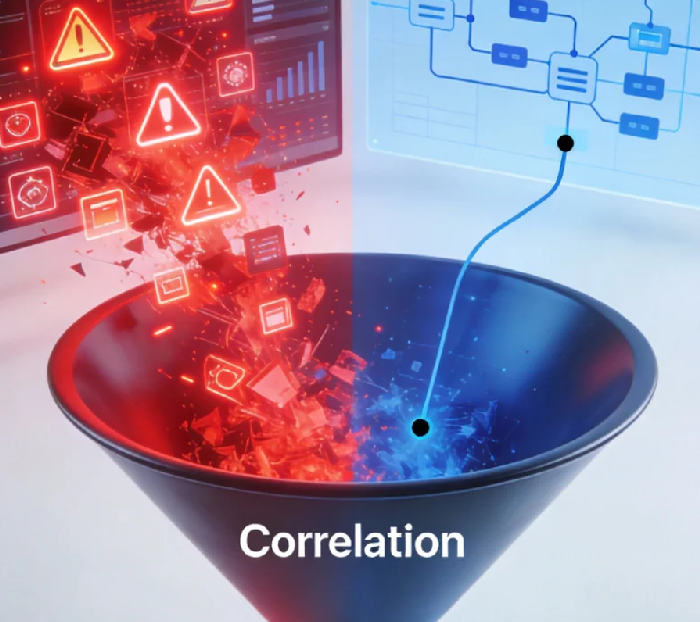
The magic happens in correlation. An observability platform doesn't just store these three data types separately; it links them. Click on a spike in a latency metric (Metric), see the list of traces that were slow during that period (Trace), and instantly pull up the error logs from the specific failing service (Log). This turns a multi-hour war room investigation into a 5-minute diagnostic session.
Part 4: The Path Forward: Evolving Your Practice
Making this shift is a journey, not a flip of a switch. Here’s a pragmatic path:
Conduct a "Signal Audit": Start by ruthlessly auditing your current alerts. For each one, ask: "Did this alert lead to a meaningful, corrective action in the last 90 days?" Use algorithms like Median Absolute Deviation (MAD) to mathematically identify and mute pure "noise metrics". Dramatically reduce volume to increase focus.
Define "Insightful" Metrics: Identify 3-5 Key Insight Metrics that directly map to user happiness and business outcomes. This could be "95th percentile end-to-end transaction latency" or "successful checkout rate." Instrument these golden signals meticulously and protect them from noise.
Implement Traces for Critical Paths: Choose your most critical, complex user journey (e.g., user login, product purchase) and implement distributed tracing. The ROI from understanding these paths is immense.
Adopt a "Question-Driven" Mindset: In post-incident reviews, stop at "The database was slow." Push further. "Why was it slow for these users and not others?" "What changed in the query pattern?" Ensure your tooling allows you to ask these ad-hoc, high-cardinality questions.
Ultimately, we must remember the goal. As Cloudflare notes, the vision is to have a single pane of glass where you can understand what is happening, where, and why. Your monitoring should not be a relentless alarm bell. It should be a quiet, intelligent guide that helps you understand the present and anticipate the future.
Stop building a system that just tells you when the house is on fire. Start building one that shows you the frayed wiring, the blocked vent, and the forgotten candle—long before the first spark ever flies. That is the difference between an alert and an insight. And that is what turns operational burden into a strategic advantage.