The Silent Tax of Idle Servers: How Much of Your Infrastructure is Asleep?
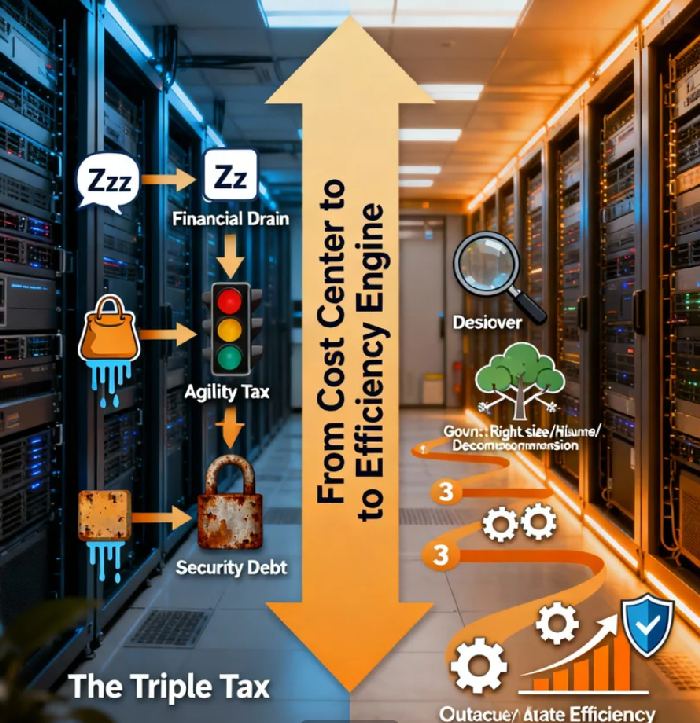
Let's start with a question that might make you uncomfortable. Right now, as you read this, what percentage of your server infrastructure—those cloud instances and physical boxes humming in data centers—is essentially comatose? CPU utilization cruising at a lonely 5%, memory vast and empty, network traffic a faint trickle, yet still consuming budget, power, and your team's attention?
This isn't a hypothetical. We're not talking about off-peak dips, which are healthy. We're talking about assets that have been functionally asleep for months, maybe years. Industry data, like the insights from the 2023 Flexera State of the Cloud Report, suggests a staggering 30% of cloud spend is wasted. But that's just the cloud bill. Extend that logic to your owned hardware, to the "just-in-case" servers bought for projects long dead, and the scale of the slumber becomes terrifying. You are almost certainly paying a massive, silent tax on idleness. It's not a line item on your invoice; it's the gap between what you pay and the value you receive.
The most insidious part? We've collectively learned to ignore it. This silent tax is levied in a currency more complex than dollars, and until we account for its full dimensions, our infrastructure will remain bloated, inefficient, and insecure.
The Triple Ledger of the Silent Tax: More Than Just Wasted Cycles
When we think of idle servers, we think of wasted compute. That's the first layer, but it's the shallowest. The true cost is a triple-entry ledger that hits your finances, your agility, and your security.
1. The Direct Financial Drain (The Obvious One). Yes, it's the ongoing bill for the cloud VM nobody uses, or the depreciation and data center rack fee for the physical server doing nothing. But even here, perception fails. A cloud instance at 5% load costs the same as one at 95% load. You're paying for potential you never tap. For physical gear, over a typical 3-5 year lifespan, the costs of power and cooling often rival or exceed the original hardware purchase price. The server sleeps, but the OPEX is wide awake, a perpetual drain.
2. The Opportunity Cost & The "Agility Tax" (The Hidden One). This is the killer. Every idle server occupies a "slot": a slice of your cloud vCPU quota, a precious rack unit, a watt of your power budget, and—most critically—a fragment of your ops team's mental bandwidth. It's clutter. When a developer needs a new environment for a breakthrough idea, the path of least resistance is always to provision something new. The time and political capital needed to find, assess, clean, and re-purpose a "sleeping" server is too high. Thus, idleness directly penalizes innovation speed. This is the "Agility Tax"—the invisible friction that slows your business down, paid for by every forgotten asset.
3. The Security & Compliance Debt (The Dangerous One). A server forgotten by the business is often forgotten by IT. It likely runs an outdated OS, with unpatched vulnerabilities, holding stale data that should have been purged for compliance. It's invisible to your active threat detection but fully visible on the network. It's the perfect beachhead for an attacker. What SecOps sees as a critical asset, DevOps sees as a ghost. This misalignment creates "security debt"—the accumulating risk of a breach, with interest compounding daily. This silent tax could bankrupt your company's reputation in an instant.
Why We Tolerate the Slumber: The Organizational Hypnosis
If the cost is so high, why is the problem so rampant? Because idleness isn't a technical failure; it's a systemic organizational one.
The Broken Procurement-to-Ops Loop: Often, the team that budgets for the server (seeking "future-proof" capacity) is not the team responsible for its efficiency years later. Decommissioning a server requires someone to assume the risk of turning it off. In the absence of clear policy, the safest career move is to do nothing. This creates a "birth-death" imbalance: infrastructure is born easily but dies only with great difficulty.
Physical "Technical Debt": We discuss technical debt in code. Idle servers are its physical manifestation. Migrating the old application off that aging box is a complex, risky project with no business sponsor. It's easier to build anew around it. The old server becomes a "zombie," part of a decaying architecture that saps productivity.
The Psychology of "Ownership": There's a powerful cognitive bias at play: Loss Aversion. Shutting down a server feels like losing capability, inviting future blame. Leaving it running feels like preserving optionality, even if that option is illusory. We choose the perceived safety of waste over the perceived risk of efficiency.
From Blindness to Insight: New Lenses for Discovery
Traditional monitoring tells you if a server is up, not if it's useful. Finding truly idle assets requires a new lens focused on business outcome, not just resource utilization.
Define "Sleep" vs. "Rest": Not all low utilization is waste. We must distinguish:
Healthy Rest: The predictable nightly low for an e-commerce site.
Chronic Sleep: Average CPU <10%, near-zero network I/O over 90 days, with no link to active business services.
Deep Coma: Meets "sleep" criteria, plus: no owner, no logged access, supporting decommissioned products.
Correlate with Business Value: The most powerful analysis marries infrastructure metrics to business data. Use application performance monitoring (APM) to trace which servers actually support revenue-critical transactions. A server costing $5,000/month that supports 0.1% of orders isn't just idle; it's a profitability sinkhole. This shifts the conversation from "IT waste" to "business inefficiency."
Leverage Cloud Cost Intelligence Tools: In cloud environments, native tools (AWS Cost Explorer, Azure Cost Management) and third-party platforms (like Harness or Spot) are indispensable. They don't just show spend; they identify idle resources, right-sizing opportunities, and orphaned storage. The goal is to move from "What's my bill?" to "What am I paying for, and is it working?"
The Wake-Up Call: A Framework for Governance, Not Just Shutdown
Finding idle servers is step one. The next step is a disciplined, humane, and systematic governance framework. The goal isn't a mindless purge; it's intelligent lifecycle management.
Phase 1: The "Amnesty" and Accountability Campaign. Declare a formal 30-45 day period. Tag every asset with a required business owner and "review-by" date. Broadcast the rule: "Claim it or lose it." This transforms a technical cleanup into an organizational process, surfacing political and emotional attachments that pure automation misses.
Phase 2: The Escalation Ladder of Actions. Don't just turn things off. Apply a graduated response:
Right-Size: Downscale that 32-core VM to 4 cores.
Hibernate & Snapshot: For dev/test or disaster recovery systems, stop the instance and keep only a disk image for pennies.
Consolidate: Use containerization to pack multiple low-utilization legacy apps onto a single modern host.
Decommission: For assets in "deep coma," execute a formal, logged decommissioning process with data sanitization. Crucially, calculate and broadcast the savings. Turn IT cost avoidance into a celebrated KPI.
Phase 3: Building the "Anti-Sleep" Immune System. Prevention is the only sustainable cure.
Embed Lifecycle Policies: Automatically tag all new resources with a "provisional expiration date." Require justification for renewal.
Architect for Elasticity: Design new workloads for platforms like Kubernetes or serverless functions, where scale (and cost) matches demand in real-time. Avoid fixed-capacity thinking.
Make Cost a DevOps Metric: Integrate cost visibility and optimization checks into the CI/CD pipeline. A deployment should be judged not only on performance and security but on its infrastructure efficiency.
Managing infrastructure isn't about hoarding potential. It's about the disciplined stewardship of capital—financial, human, and innovative. Those idle servers in your estate aren't just machines; they are frozen commitments, capital that cannot be deployed toward your future.
The journey from waste to efficiency isn't a one-time project. It's a cultural shift from seeing infrastructure as a static collection of assets to viewing it as a dynamic, fluid resource that must constantly justify its existence. It's about breaking the hypnosis, opening the triple ledger, and deciding that you will no longer pay the silent tax for dreams your servers are no longer having.
So tonight, when the office is quiet, pull up your dashboard. Don't look for what's broken. Look for what's barely breathing. That's where your next major win—in budget, in speed, in security—is waiting to be claimed.