Is Serverless the Future? A Deep Dive Into Its Benefits, Limitations, and Coexistence With Traditional Servers
3:00 AM. Another pager alert—but this time, it's different. The CPU isn't too high. It's too low. That 8-core, 32GB server you provisioned last month has been averaging 3% utilization. You stare at the bill and realize the ugly truth: you're paying for 100% of capacity and using less than 10%. Meanwhile, your competitor across town is running on serverless, paying exactly zero for their idle time.
This is the moment serverless vendors want you to have. The moment you question everything you thought you knew about infrastructure.
But before you jump, let's talk honestly about what serverless actually is—and isn't.
01 What Serverless Actually Is (And Isn't)
"Serverless" might be the most successful marketing term in cloud history. It makes you believe the servers disappeared—like "wireless" made cables vanish. The truth? The servers are still there. There are more of them than ever. You just can't see them anymore .
Serverless, at its core, is event-driven functions + pay-per-execution pricing + zero infrastructure operations. You write code, upload it, and when something triggers it—an HTTP request, a file upload, a queue message—it runs for milliseconds to minutes, then vanishes. You pay for exactly that execution time, billed in millisecond increments .
The global serverless market is projected to hit $104.75 billion by 2032, growing at over 24% annually . That's not hype—that's companies voting with their wallets against paying for idle capacity.
But serverless isn't a single "thing." It's a spectrum. Pure FaaS (Function-as-a-Service) like AWS Lambda sits at one end. Managed containers (Google Cloud Run) sit in the middle. "Serverless" databases and queues live somewhere else entirely. Each level of abstraction trades control for convenience .
02 The Real Advantages: Why Big Tech Is Betting on This
1. Elasticity Isn't "Can Scale"—It's "From Zero to Infinity and Back"
Traditional auto-scaling means fussing with a few to a few dozen VMs. Serverless auto-scaling means going from 0 to 1,000 to 0, smoothly, automatically. Research on SMEs shows serverless architectures scale 10x faster than traditional VMs under bursty workloads .
Think about that: your app could have three users all morning, then 3,000 requests in 30 seconds during a flash sale. Serverless handles that pulse naturally. You pay nothing for the idle morning and exactly for the busy 30 seconds.
2. The Cost Model: Stop Paying for "Might Need"
Traditional servers are prepaid and fixed. You buy an 8-core box—you pay for it whether you use 10% or 100%.
Serverless is postpaid and variable. A 2025 study found that for variable workloads, serverless delivers 47-62% cost savings compared to traditional infrastructure . That's not optimization. That's arithmetic.
3. Developer Velocity: From Plumbing to Product
This might be the most underrated win. When your team stops worrying about OS patches, kernel updates, load balancer configs, and capacity planning, they focus on business logic. One CTO told me: "We used to spend three days a month fixing servers. Now we spend three minutes looking at the bill."
03 The Brutal Truths: Why Serverless Isn't a Silver Bullet
If serverless is so great, why isn't everyone using it for everything?
1. Cold Starts: The Tax You Can't Escape
This is serverless's most infamous pain point. When a function hasn't been invoked in a while, the platform needs to reinitialize—pull code, load dependencies, start the runtime. That takes time. Sometimes hundreds of milliseconds. Sometimes seconds.
Research shows over 80% of cold start latency comes from application-layer code initialization—bloated imports, unnecessary dependencies . Python workloads importing NumPy or PyTorch can see cold starts spike by 90% just from library loading .
For user-facing APIs or real-time applications, those milliseconds matter. Amazon once reported that every 100ms of latency costs 1% in sales. Google saw 500ms extra latency drop search traffic by 20% .
2. Vendor Lock-In: Easy In, Hard Out
This is the second致命 wound. When you start using AWS Lambda's triggers, Azure Functions' bindings, or any cloud-specific API, your application becomes deeply coupled to that platform .
A recent U.S. Navy procurement document admitted that because they'd deeply integrated Microsoft Azure's proprietary services, switching providers would mean "redesigning the entire solution from scratch" . If the Navy can't escape vendor lock-in, what makes you think you can?
Migrating a traditional Node.js app might take days. Migrating a serverless app heavy on cloud-native integrations can take months to a year of redevelopment .
3. Debugging Complexity: The Distributed Systems Curse
Serverless apps are inherently event-driven and distributed. One user request might trigger five functions, cross three cloud services, and generate 200 log lines. Traditional debugging tools break here .
You need distributed tracing, correlation IDs, and automated observability—all of which have steep learning curves.
4. Where It Doesn't Belong
The same SME study found that for sustained, steady workloads, traditional VMs are still 12-18% cheaper than serverless . It's basic economics: when your server never sleeps, reserved instances win.
Stateful applications, long-running processes, and latency-critical core transactions—these are places where serverless is often the wrong answer .
04 The Coexistence Model: Why Hybrid Serverless Wins
If you expected me to give you an "A or B" answer, sorry. The real answer is "both, thoughtfully" .
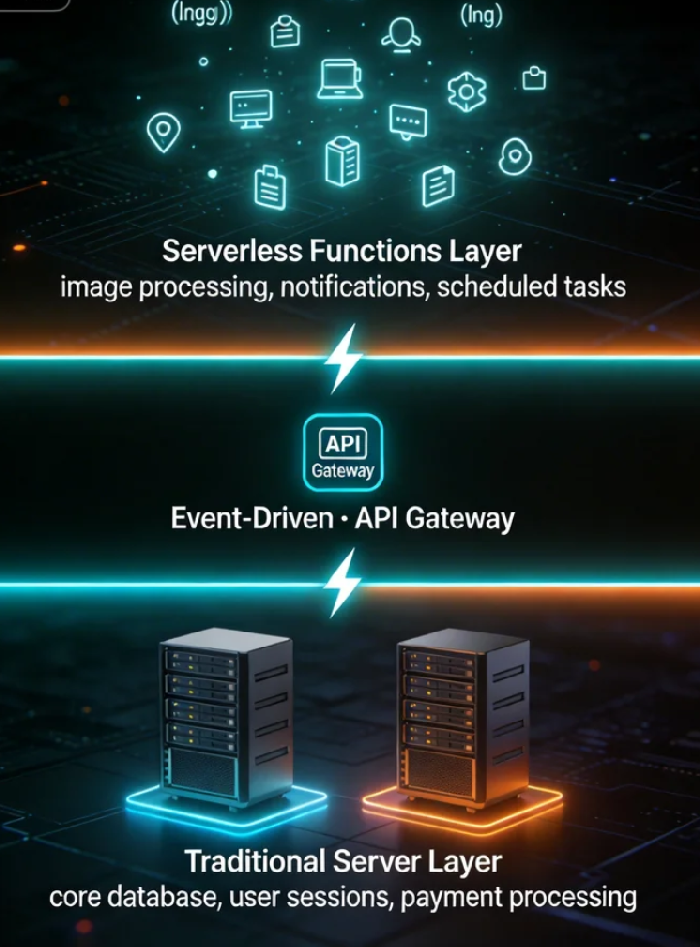
This pragmatic approach has a name: hybrid serverless architecture—combining serverless functions with containerized or VM-based services, often spanning on-prem and cloud .
In practice, this means:
Event-driven serverless functions handle bursty, stateless, or integration-heavy workloads
Containers or VMs manage long-running, stateful, or latency-sensitive services
Both models share networking, identity, observability, and governance layers
Research shows that for mixed workloads, this approach can reduce total cost of ownership by 33% . That's not compromise. That's optimization.
The Decision Framework
Three questions to guide you:
Is the workload steady or bursty?
Steady → VMs/containers
Bursty → Serverless
How extreme are your latency requirements?
P99 < 100ms → Avoid pure serverless, consider pre-warming or hybrid
P99 can tolerate >200ms → Serverless is viable
Is your team ready for distributed systems complexity?
No → Start with simple, non-critical serverless use cases
Real-World Hybrid Patterns
A typical hybrid architecture might look like this :
| Component | What Runs It |
|---|---|
| Core database | Bare metal or VMs |
| User session state | Managed cache (Redis) or VMs |
| Web/API tier | Cloud servers (auto-scaling) |
| Image processing | Serverless functions |
| Notification delivery | Serverless functions |
| Scheduled reporting | Serverless functions |
| Payment processing | VMs (compliance requirements) |
A user action triggers a serverless function. That function validates input, enriches data, then hands off compute-heavy work to a containerized service. Results flow back asynchronously. Each piece runs where it runs best .
05 Don't Ask "Is It the Future?" Ask "Does It Fit Right Now?"
The best serverless practitioners I've met aren't zealots who moved their core transaction systems to Lambda. They're strategic about where they deploy it.
They peel off user upload processing, image transcoding, notification delivery, scheduled tasks—important but non-critical work—and give it to serverless. Their core databases, user state, payment systems stay on servers they can see and control.
One friend summarized it perfectly: "We save 40% on infrastructure costs annually. Not because serverless is cheap—because we finally stopped paying for capacity we might need."
Serverless isn't the future. It's already the present . But it's not the whole present. The real wisdom isn't choosing one path and walking it blindly. It's using the right tool for each job.
So next time someone declares "serverless is the future," ask them: "What about my database? My user sessions? My core transactions?"
The answer won't be "serverless-ify those too." It'll be: they'll coexist. Elegantly. Deliberately. Profitably.
That's not a compromise. That's maturity.
*Data sources: SME serverless adoption study (2025) ; hybrid architecture research ; cold start analysis ; vendor lock-in study *