It's 3 AM, and your phone buzzes again. You've lost count. A server disk is full—again. You SSH in, muscle memory taking over:
rm -rf /var/log/*.old, hit Enter, stare at the prompt until it returns. In the morning standup, your manager asks, "What happened last night?" You say, "Disk filled up, I cleaned it manually." He nods. You look down—because you know, same time next week, you'll do it all over again.
This isn't operations. This is human-powered pager duty.
If you're still logging into servers by hand, running the same commands at 3 AM, you're not alone. But today, let's talk about something different: When will you stop needing to wake up and type commands manually?
01 The Three Sins of Manual SSH
Logging into servers and typing commands is the most primitive, direct, and oddly satisfying way to operate infrastructure—because it's fast, because it makes you feel "in control."
But that feeling is a dangerous illusion.
Sin #1: It's not repeatable.
You ran that disk cleanup command last night. You could run it again tonight. But next month? When a new teammate joins, they won't know "the old way." Every incident becomes a fresh adventure, every recovery an improvisation. There's no institutional memory in your fingertips.
Sin #2: It's not auditable.
Who logged into which server, when, and ran what commands? If your answer is "I think I remember," your system is out of control. When security auditors come knocking, what proof do you have that you didn't do anything shady?
Sin #3: It doesn't scale.
You can manage 10 servers by hand—SSH in, type commands, maybe it's tolerable. 100 servers? 1000? When you scale by an order of magnitude, the complexity of manual operations explodes exponentially. You're not operating; you're fighting physics with your bare hands.
So saying goodbye to manual SSH isn't a slogan—it's survival.
02 Two Keys: Terraform and Ansible
Plenty of tools exist, but two form the bedrock of modern operations.
Terraform: Turning Infrastructure into Code
First question: How many servers do you have right now? How were they created? If your answer involves "I clicked around in the cloud console," we need to talk.
Terraform's core idea is declarative infrastructure—you write code describing "what I want" (three 2-core, 4GB servers, with this security group, attached to that storage), and Terraform makes reality match your description.
What does this mean in practice?
Repeatability: The same configuration can spin up identical environments for dev, staging, and production. No more "works on my machine."
Version control: Your infrastructure config lives in Git. Every change has a history. You can diff, review, and roll back.
Collaboration: Teams review infrastructure changes like code, preventing "who clicked what in the console and broke prod?"
Ansible: Automating Configuration Management
Now servers exist. Next, you need to install software, tweak configs, deploy apps. That's where Ansible shines.
Ansible is agentless, works over SSH (yes, it uses SSH too, but differently from your manual typing), and describes desired state in YAML. You write a playbook: "All web servers should have Nginx installed, with this config file, and the service running." Ansible makes it so.
Its superpowers:
Idempotence: Run the same playbook a thousand times, you get the same result. No "oops, I fat-fingered it" surprises.
Consistency: Every server ends up identical. No "this one seems slightly different" mysteries.
Automation: Plug into CI/CD pipelines—commit code, trigger config updates automatically.
03 Three Counter-Intuitive Truths
In helping dozens of teams transition from manual to automated, I've noticed some patterns that defy common wisdom.
Truth #1: Automation isn't about speed—it's about stability
Most people think automation's goal is to make operations faster. Wrong. The real payoff is eliminating variability.
Every manual step is an opportunity for error. A missing character, an extra space, a wrong path—these "human bugs" are the leading cause of operational incidents. Automate, and the same operation runs the same way every time. Stability improves exponentially.
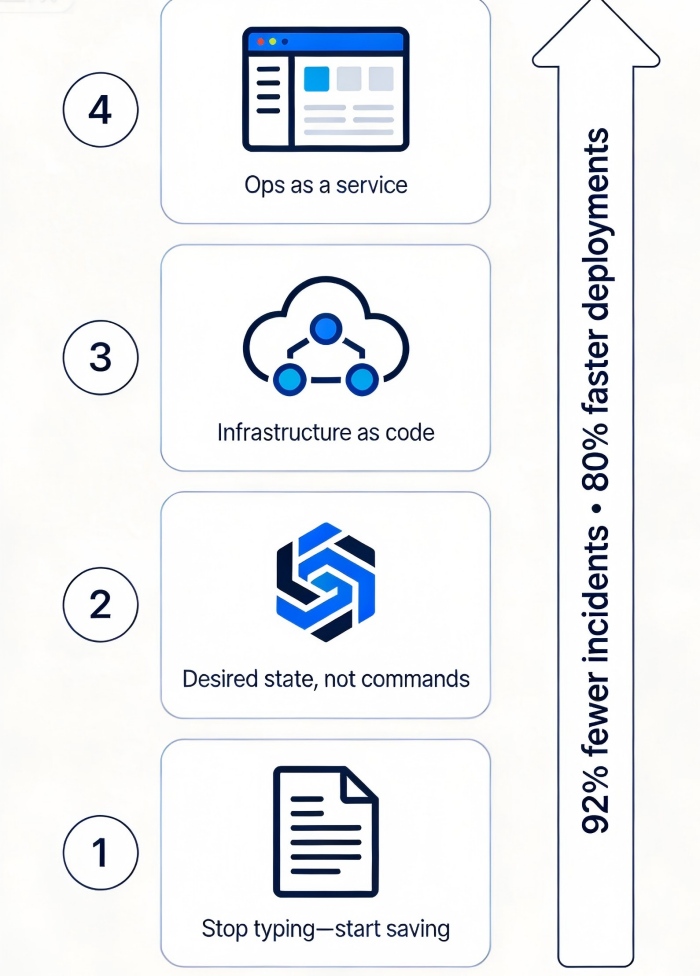
There's a reason teams that adopt Infrastructure as Code see a 92% reduction in configuration-related incidents . Not faster—just almost never wrong.
Truth #2: Automation doesn't eliminate humans—it elevates them
People worry: "If we automate everything, what will I do?"
Here's the truth: Automation kills repetitive work, not the need for human judgment. You won't be cleaning disks at 3 AM anymore, but you'll be figuring out why disks keep filling up, designing better monitoring, and creating smarter cleanup policies. You won't be deploying 100 servers by hand, but you'll design deployment strategies that are safer, faster, and more resilient.
In other words, automation turns you from a manual laborer into a knowledge worker.
Truth #3: The hardest part isn't the tech—it's the discipline
Technically, neither Ansible nor Terraform is hard to learn. What's hard is sticking to the rules:
Every change, even a single port tweak, must go through code, pull request, review, pipeline—no "quick SSH fix."
Every change must be recorded. No "I'll update the config later" exceptions.
Environment differences must live in code. No "dev is patched but prod forgot."
I've seen teams with all the tools in place still SSH into production to "just fix this one thing." Not because the tools failed—because they couldn't resist the temptation.
04 The Four Steps from Manual to Automated
If you're still in the manual SSH era, don't try to leap to full automation overnight. It's a journey with distinct stages:
Step 1: Scripting
Take your most common tasks, turn them into scripts, and put those scripts in version control. This isn't automation yet, but it's already better than typing from memory.
Step 2: Templating
Use Ansible to turn your scripts into repeatable playbooks. This forces you to think in terms of "desired state" rather than "commands to run."
Step 3: Codifying
Bring in Terraform to make your infrastructure itself code. Now your entire environment—from cloud resources to software config—is reproducible and versioned.
Step 4: Platforming
Package your automation into services, so developers can spin up test environments with a few clicks in a self-service portal. This is the endgame, and it's what many large orgs are building toward.
Don't feel pressured to reach Step 4 overnight. If you get to Step 2, you've already left the manual SSH era behind.
05 A Simple Starting Point
After all this talk, you might be wondering: "Where do I even begin?"
I suggest this: Next week, when you have a change to make, force yourself to write an Ansible playbook instead of SSH-ing in.
Even if it's just tweaking a config file or restarting a service. It'll feel slower at first. But when you're done, you'll have an asset—a repeatable automation that works next time. And there will be a next time.
Try it. I promise: the feeling of your first successful automation run beats the satisfaction of fixing a server at 3 AM by a hundred times. Because you know you'll never have to fix it again.
The Bottom Line
I used to be a heavy manual SSH user. I thought typing commands was the only way to truly feel in control. Until one night, at 4 AM, I used Ansible to update 50 servers in under five minutes, zero errors, and went back to sleep.
That's when I understood: True control isn't about how much you do yourself. It's about knowing you don't have to do it.
The era of manual SSH is ending. Not because it doesn't work, but because we have more important things to do.
Is your team still stuck in the manual past? Today is the day to start the climb.