Last week, a friend building a cross-border e-commerce platform asked me: "We're expanding overseas. Should we go with AWS or Alibaba Cloud? I heard AWS has better global coverage, but Alibaba is cheaper. What do you think?"
I asked him back: "Where are your users? Which platform does your team know better? Any compliance requirements?"
He paused. "Haven't thought that far. Just wanted to compare prices first."
This is how most cloud selections start—open two pricing pages, pick the cheaper one.
But after years of helping companies choose clouds, I've learned something: The cloud you pick based on price alone usually ends up costing you the most.
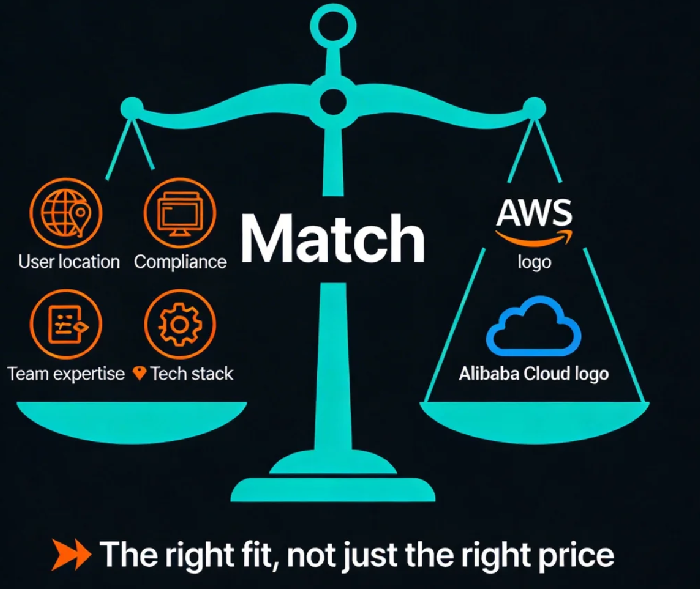
Today, let's talk about the real differences between AWS and Alibaba Cloud. Not a feature checklist, but a decision framework that helps you ask the right questions.
01 First, Understand You're Picking a Home Field
Both AWS and Alibaba Cloud are top-tier providers. Technically, they're both capable. But each has its own home field advantage.
AWS's home field is North America, Europe, and the global enterprise market. They started early, built a massive ecosystem, and now have 25 regions and 80 availability zones worldwide. Their density in the US and Europe is unmatched. If your users are primarily in North America or Europe, or you're building a global SaaS, AWS is the safer bet.
Alibaba Cloud's home field is Asia Pacific, especially Greater China. Domestically, their coverage is the most comprehensive. Compliance with Chinese regulations? Second nature. In Southeast Asia, they've also invested heavily—Singapore, Malaysia, Indonesia all have well-optimized nodes. If your business is China-based expanding into Southeast Asia, Alibaba often delivers better performance and cost.
This isn't to say AWS is unusable in Asia, or Alibaba is hopeless in Europe. It's about density, network optimization, and local support. A user in Southeast Asia accessing a Singapore node on Alibaba might get an optimized local route. On AWS, that same request might hop through another region first. That's tens of milliseconds of difference—and milliseconds matter.
02 Compare Price, But Don't Just Look at the Hourly Rate
Open both websites, compare the same instance specs, and you'll probably conclude: Alibaba is cheaper.
But this comparison has several traps:
First, reserved instances are your real cost. On-demand pricing is for temporary workloads. Who buys long-running servers on-demand? Both clouds offer reserved instances (RI) and savings plans. The gap can narrow—or even reverse—once you factor those in.
Second, data transfer often dominates your bill. In cloud economics, compute might be 30-40% of your total cost. Bandwidth is the real long-term expense. AWS international bandwidth is expensive, but their domestic (US) bandwidth is cheaper. Alibaba has an edge in China bandwidth, but international rates vary by route. You have to model your actual traffic patterns.
Third, ecosystem services have different pricing strategies. Storage, databases, CDN—each cloud prices these differently. One might have cheap compute but expensive storage. Compare only EC2 vs ECS is like buying a car based solely on the engine.
Counter-intuitive truth: AWS can be cheaper than Alibaba in some scenarios. If you use Spot instances heavily, or deeply commit to reserved instances, plus enterprise discounts—AWS's long-term cost might surprise you. Always calculate total cost, not unit price.
03 Compare Features, But Ask If You'll Actually Use Them
Both clouds have feature lists that scroll forever. But do you need them?
I once worked with a startup that chose AWS because "we might need those 200+ services someday." Two years later, they'd only used EC2, S3, and RDS. They'd spent countless hours learning services they never touched.
The principle: Good enough is good enough. What you don't use is just cost.
AWS's strength is ecosystem depth: Lambda, Aurora, Redshift, SageMaker—each is an industry leader. If your business heavily depends on these advanced services, AWS has a clear edge.
Alibaba's strength is integrated experience: Their services work together more seamlessly. The console is unified. The learning curve is gentler. For small to medium teams, or businesses focused on China, Alibaba's "family bucket" approach just feels smoother.
One more thing: documentation and support language. This isn't about politics—it's about efficiency. Does your team read English docs faster, or Chinese? When you open a support ticket, how much faster is native-language communication? These soft factors affect your long-term cost too.
04 Compare Compliance, But Don't Wait Until You're Audited
Compliance is one of those things nobody thinks about until it's too late.
AWS's compliance certifications lean international: ISO 27001, SOC, PCI DSS, HIPAA. These matter in US and European markets. If you're doing B2B in the West, especially in finance or healthcare, AWS's compliance credentials give customers confidence.
Alibaba's compliance strength is domestic: MLPS (Multi-Level Protection Scheme),工信部 certifications, Cybersecurity Law compliance. If you're handling Chinese user data or operating in China, Alibaba's local compliance experience is invaluable.
One overlooked factor: data residency requirements. Some industries (finance, government) mandate data stay within country borders. If your client requires data not leave Singapore, you need a provider with a Singapore region. AWS has Africa; Alibaba has Indonesia. Match your nodes to your compliance needs.
05 Compare Ecosystems, But Match to Your Stack
AWS's ecosystem is unmatched. Almost every open-source tool, every third-party service, integrates with AWS first. Terraform, Ansible, Kubernetes, Prometheus—they all run smoothest on AWS. If your team loves chasing new tech, AWS will save you headaches.
Alibaba's ecosystem is strong in China, but leans toward local ISVs (independent software vendors). Yonyou, Kingdee, Salesforce China—these integrate better with Alibaba. If your business relies heavily on domestic SaaS, Alibaba is the smoother path.
One more angle: talent pool. Is it easier to hire engineers who know AWS, or who know Alibaba? Depends on your market. In China, Alibaba talent is more abundant. In the US and Europe, AWS skills dominate.
06 A Decision Framework: Seven Questions to Ask Yourself
Let's turn all this into a practical framework. Next time you're choosing, ask yourself these questions:
1. Where are your users?
Mostly North America/Europe → AWS
Mostly China/Southeast Asia → Alibaba Cloud
Global mix → Both viable, but consider multi-cloud
2. What compliance requirements do you have?
International certs (ISO, SOC, HIPAA) → AWS
Domestic China certs (MLPS, etc.) → Alibaba Cloud
Data residency requirements → Match region to provider
3. Which platform does your team know?
Familiar with AWS → Lower migration cost
Familiar with Alibaba → Lower migration cost
Neither → Decide based on other factors
4. Do you need advanced services?
Heavy Lambda, Aurora, SageMaker usage → AWS
Heavy reliance on China ISVs → Alibaba
Just basic compute/storage → Both viable, compare total cost
5. What's your budget model?
Short-term elastic workloads → Compare on-demand
Long-term steady state → Model reserved instance discounts
6. What's your tech stack preference?
Open-source, global community → AWS
China ISV integrations → Alibaba
7. Could you go multi-cloud in the future?
Yes → Design for multi-cloud now, avoid deep lock-in
The Bottom Line
That friend with the e-commerce platform? He ended up choosing Alibaba Cloud. Not because it was cheaper—because 70% of his users were in Southeast Asia, his team was in Shenzhen, and they weren't using any advanced AWS services anyway.
He told me later: "I used to think choosing a cloud was a technical decision. Now I realize it's a business decision."
I think he's right. AWS and Alibaba are both excellent clouds. The difference is which one fits your current stage, your user distribution, your team's DNA, your compliance needs. Choose right, and everything gets easier. Choose wrong, and you'll spend years patching bad decisions.
There's no "best" cloud. Only the "most suitable" cloud for you. Next time you're comparing, don't just open the pricing page. Ask yourself the seven questions first.